
Among all the deities of the Hindu pantheon, Goddess Kali stands out as one of the most powerful, mysterious, and transformative figures. She is both feared and adored — a deity who destroys demons and yet embodies the tender love of a mother. As the goddess of time, destruction, and transformation, she represents the fierce aspect of the Divine Mother, Shakti, the primordial energy that sustains the universe. Kali is the power that ends illusions, liberates souls from ignorance, and reveals the eternal truth of existence.
Her image — dark, fierce, and adorned with skulls — is often misunderstood as terrifying. Yet, at its core, Kali symbolizes freedom from fear, spiritual awakening, and the inevitable cycle of creation and destruction that governs the universe. Understanding her history and various forms provides a profound insight into Hindu spirituality and the philosophy of divine energy.
Historical Origins of Goddess Kali
Vedic Roots and Early References
The roots of Kali’s worship go back thousands of years. Early references to a dark, warlike goddess can be found in the Rigveda (circa 1500 BCE), where the name Kali appears as one of the seven tongues of the fire god Agni. In this early form, she symbolizes destructive energy — a necessary counterpart to the creative forces of the universe. Though not yet the independent goddess of later times, this Vedic Kali reveals the seeds of her later power.
In the Atharvaveda and other early texts, the concept of divine feminine energy (Shakti) began to develop, leading to the emergence of goddesses associated with fertility, war, and protection. Kali, as an independent entity, became more defined in later Puranic and Tantric literature.
The Puranic Emergence: The Devi Mahatmya
The earliest comprehensive portrayal of Kali appears in the Devi Mahatmya, a section of the Markandeya Purana (c. 5th – 6th century CE). Here she emerges from the brow of Goddess Durga (also known as Chandika) during a cosmic battle against the demon Raktabīja.
Raktabīja’s special power was that every drop of his blood that touched the ground produced another demon identical to him. To overcome this seemingly invincible enemy, Durga emanated Kali, a dark, ferocious goddess who extended her enormous tongue over the battlefield and drank every drop of the demon’s blood before it could fall. Through this act, Kali annihilated him completely, restoring cosmic balance.
This narrative defines Kali’s essential nature — she is the force that consumes evil and illusion, the destroyer of ignorance that reproduces endlessly unless destroyed at its root.

The Dance of Destruction and Shiva’s Intervention
Another significant myth describes Kali’s uncontrollable rage after her victory over demons. Having destroyed all forces of evil, she began her dance of annihilation (Tandava), threatening to destroy the entire cosmos. To calm her, Lord Shiva, her divine consort, lay down in her path. When Kali stepped on his chest and realized she had hurt her beloved, she bit her tongue in shock and ceased her dance.
This image — Kali standing on Shiva with her tongue protruding — is the most iconic representation of the goddess. It symbolizes the dynamic relationship between Shakti (Energy) and Shiva (Consciousness). Shiva is lifeless without Shakti, while Shakti is aimless without Shiva.. Together, they sustain creation.
Historical Spread and Worship Traditions
The worship of Kali gained immense prominence in Bengal, Assam, and Odisha from the medieval period onward. The Tantric texts such as the Kalika Purana (10th century CE) and Tantrasara elaborated her rituals and philosophy, portraying her as the ultimate reality (Brahman).
During the Bengal Renaissance, Kali became a central figure of spiritual devotion. Saints like Ramakrishna Paramahamsa (19th century) experienced direct visions of Kali as the compassionate Mother of the Universe. His teachings emphasized that the terrifying form of Kali hides boundless love — she destroys only to protect and liberate her children.
Even today, Kali Puja, celebrated on the new moon night of Diwali, is one of Bengal’s most important festivals. Millions worship her as the destroyer of darkness and the giver of liberation.
Symbolism and Philosophy of Goddess Kali
Kali’s imagery is filled with profound philosophical symbolism that reflects the core principles of Hindu thought — the unity of creation and destruction, illusion and truth, death and immortality.
1. The Dark Form
Kali’s color — black or deep blue — represents the cosmic void, the source from which all existence emerges and to which it returns. Just as all colors dissolve in black, so does all creation dissolve in her. Her darkness symbolizes the infinite nature of time and the unknowable mystery of the divine.
2. Nakedness
Kali is often depicted naked, symbolizing absolute purity and freedom from illusion (Maya). She is beyond the dualities of modesty and shame, good and evil. Her nudity reflects the unconditioned truth that transcends social constructs.
3. Garland of Skulls and Severed Heads
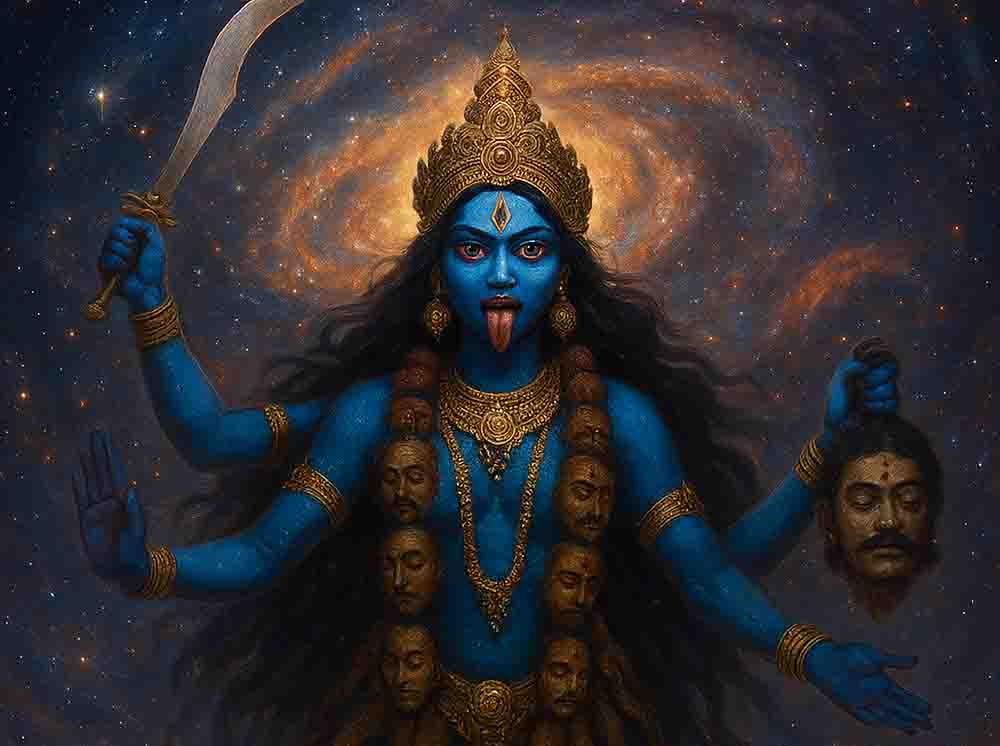
Kali wears a garland of human skulls and a girdle of severed arms. These are not signs of cruelty but of liberation. Each skull represents a letter of the Sanskrit alphabet — together, they symbolize sound and creation. The severed heads signify the destruction of ego and ignorance, freeing the devotee from the bondage of the material world.
4. Her Four Arms
In most depictions, Kali has four arms. In two hands, she holds a sword (symbolizing wisdom) and a severed head (representing the ego). The other two hands are raised in gestures of blessing (varada mudra) and fearlessness (abhaya mudra). Thus, she both destroys and protects — death and compassion coexist in her essence.
5. Standing on Lord Shiva
Kali’s posture atop Lord Shiva embodies one of Hinduism’s deepest spiritual truths: energy and consciousness are inseparable. Kali is Shakti, the active power of creation; Shiva is Pure Consciousness, the still observer. When energy acts without awareness, it becomes chaotic — hence Kali’s wild dance. When united with consciousness, it leads to harmony and liberation.
6. Her Tongue
Kali’s protruding tongue has several interpretations. In the Devi Mahatmya, she licks up Raktabīja’s blood to prevent its multiplication. Symbolically, her tongue represents control over the life force — she consumes negativity and purifies existence. In the myth of Shiva’s intervention, the tongue signifies shame and compassion, showing that even the fiercest energy bows to love.
Spiritual Significance
Philosophically, Kali represents Time (Kala) itself — the unstoppable force that devours everything. She teaches the impermanence of the material world and urges devotees to seek the eternal truth.
In spiritual practice, Kali is invoked to destroy inner demons — fear, anger, greed, and ego. Her worship leads to transformation: she “kills” ignorance so that true knowledge can emerge.
In Tantric philosophy, she is not merely a deity but the ultimate reality (Brahman) — the dynamic aspect of the absolute. She is both the cause and effect, the womb and the grave, the beginning and the end. For Tantrics, worshipping Kali means embracing all aspects of life — creation, preservation, and destruction — with equal reverence.
Major Forms of Goddess Kali
Over the centuries, Kali has manifested in many forms, each emphasizing a different aspect of her divine power. While some forms are gentle and nurturing, others are fierce and transformative. Below are her most prominent manifestations:
1. Dakshina Kali
Dakshina Kali is the most widely worshipped form of the goddess, especially in Bengal. She is shown standing on Shiva with her right foot forward — a posture symbolizing benevolence and compassion.
In her right hands, she offers blessings and protection; in her left, she holds a sword and a severed head. Dakshina Kali represents Motherly Love combined with the power to destroy ignorance. She is considered approachable and compassionate, granting both material and spiritual boons to her devotees.
2. Shamshan Kali (Kali of the Cremation Ground)
Shamshan Kali is the fierce, ascetic form of the goddess who dwells in cremation grounds. She represents transcendence over death and illusion. Her worship is especially popular among Tantric practitioners who meditate in cremation grounds to conquer the fear of death and the ego.
This form symbolizes the truth that life and death are inseparable. By meditating on Shamshan Kali, devotees learn detachment and the impermanence of worldly existence.
3. Bhadra Kali
Bhadra Kali, meaning “the auspicious one,” is worshipped mainly in South India, particularly in Kerala, Tamil Nadu, and Andhra Pradesh. Unlike the terrifying forms, Bhadra Kali is protective and benevolent. She guards her devotees against misfortune and evil influences.
According to legend, she emerged from the anger of Goddess Parvati to slay the demon Daruka. Her temples are centers of fertility, prosperity, and protection rituals. Bhadra Kali symbolizes divine justice and the power of righteous anger.
4. Mahakali (The Great Kali)
Mahakali is the cosmic form of Kali, encompassing the entire universe. She is often depicted with ten heads, ten arms, and ten legs, representing her dominion over the ten directions of space and time. Mahakali transcends creation — she is the goddess of time itself, devouring everything at the end of each cosmic cycle.
In philosophical terms, Mahakali is identical with the Supreme Reality. She governs the three primary forces of the universe — creation (Sattva), preservation (Rajas), and destruction (Tamas). Worship of Mahakali leads to ultimate liberation (moksha), as she destroys the illusion of separateness between the self and the divine.
5. Guhya Kali (The Hidden Kali)
Guhya Kali, or the “Secret Kali,” is a mystical form known primarily in Tantric traditions. She represents hidden wisdom and the inner transformation that occurs through meditation.
Guhya Kali is not depicted in temples but experienced inwardly through deep spiritual practice. She reveals the mysteries of consciousness and the unity of opposites — life and death, light and shadow. Her worship leads to self-realization and enlightenment.
6. Kamalatmika Kali (Kali as the Lotus Goddess)
Kamalatmika Kali combines the fierce energy of Kali with the grace and abundance of Goddess Lakshmi, who is associated with the lotus (Kamal). This form symbolizes the union of spiritual power and material prosperity.
She teaches that wealth and beauty are not obstacles to spirituality when used with wisdom. Kamalatmika Kali helps devotees achieve balance — material success that complements, rather than hinders, spiritual growth.
7. Raksha Kali and Samhara Kali
- Raksha Kali (“Protective Kali”) is invoked for safety during wars, epidemics, and disasters. She shields devotees from external harm and internal weakness.
- Samhara Kali (“The Annihilator”) represents the destructive aspect of time that dissolves everything at the end of creation. She embodies the natural cycle of death leading to rebirth.
These forms remind humanity of the goddess’s dual nature — fierce yet protective, destructive yet deeply compassionate.
Cultural and Religious Importance
Kali’s worship transcends regional boundaries. In Eastern India, she is the presiding deity of West Bengal and Assam. The grand celebration of Kali Puja coincides with Diwali, the festival of lights. While other parts of India worship Goddess Lakshmi on this night, Bengalis light lamps for Kali, seeking her protection and guidance.
In Nepal, Kali is revered as Kalika Mata, and in Bangladesh, her temples remain important pilgrimage centers. In South India, Bhadra Kali temples play a crucial role in local culture and temple festivals, featuring traditional dances like Theyyam and Bhadrakali Pattu.
Globally, Kali has also become a symbol of feminine empowerment. Feminist movements and spiritual seekers see her as the archetype of a strong, independent woman who breaks boundaries and destroys oppression. Artists, writers, and philosophers interpret her as the energy of revolution and inner awakening.
Theology and Worship Practices
Worship of Kali takes many forms — from simple household devotion to esoteric Tantric rituals. Devotees chant her mantras, such as:
“Om Krim Kalikayai Namah”
The syllable Krim (pronounced “kreem”) is her seed sound (bija mantra), representing her primal energy. Offerings of red hibiscus flowers, incense, rice, and sweets are common, as red symbolizes her fiery nature.
In Tantric traditions, meditation on Kali involves visualizing her fierce form, symbolizing the confrontation with one’s own fears and ego. Through this process, the practitioner attains freedom from attachment and realizes the unity of life and death.
Devotees also recite the Kali Sahasranama Stotra (Thousand Names of Kali) and the Karpuradi Stotra, which praise her cosmic qualities.
Philosophical Message of Kali
Kali’s message is deeply philosophical: everything that begins must end, and within that end lies the seed of rebirth. Her destruction is not evil — it is transformation. She reminds humans of impermanence and encourages spiritual growth by shedding ego, fear, and illusion.
Kali also represents acceptance of all aspects of life — joy and sorrow, creation and decay, beauty and horror. True spirituality, she teaches, is not the denial of life’s darker sides but their understanding and integration into a higher truth.
In this sense, Kali is both teacher and mother, guiding her devotees through darkness toward light. She liberates, not by giving comfort, but by shattering falsehoods so that truth can emerge.
Conclusion
Goddess Kali is one of Hinduism’s most profound symbols of divine power and transformation. From her ancient Vedic roots to her central place in modern spirituality, she continues to inspire awe, devotion, and philosophical reflection.
Her fierce imagery conceals the deepest compassion — she destroys only to protect, ends only to renew. Through her many forms — Dakshina Kali, Bhadra Kali, Shamshan Kali, and Mahakali — she encompasses every aspect of existence, from the material to the cosmic.
Kali teaches humanity to face fear, embrace change, and realize that death itself is not an end but a passage into higher consciousness. She is time, destiny, energy, and liberation — the eternal power that dances upon the body of illusion, calling every soul toward truth.
In her terrifying yet tender form, Kali remains the Mother of the Universe, forever reminding her devotees that even in destruction lies divine grace, and through surrender to her power comes the ultimate freedom — Moksha, liberation from the cycle of life and death.