
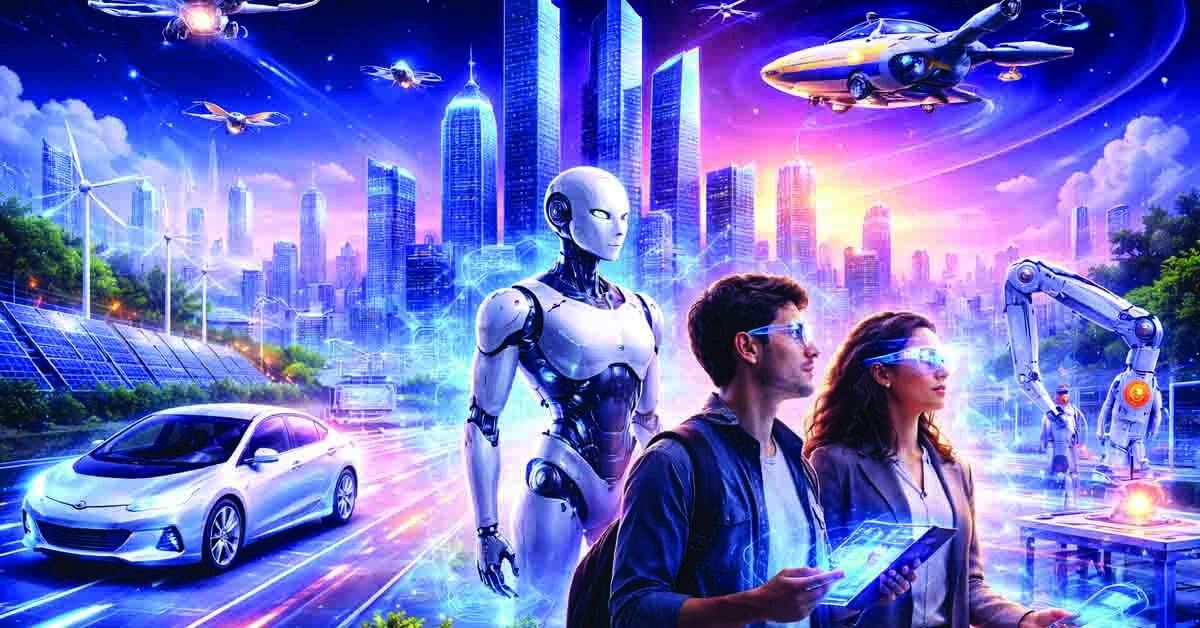

Technology is advancing faster than ever before. What once felt like science fiction—talking to machines, self-driving cars, or editing human genes—is rapidly becoming reality. Over the next 5–10 years, emerging technologies are expected to transform nearly every part of our lives, including education, healthcare, transportation, communication, and employment.
This article explores some of the most important future technologies that are likely to shape the world in the coming decade.
Artificial Intelligence Becoming Truly Personal
Artificial Intelligence (AI) is already used in phones, apps, and online platforms, but future AI will be far more advanced and deeply integrated into daily life. Instead of simple assistants, AI systems will act like personal advisors—helping students study, guiding career choices, managing finances, and monitoring health.
In workplaces, AI will automate repetitive tasks such as data entry, scheduling, and basic customer service. This will allow humans to focus more on creativity, leadership, and problem-solving. However, it will also change job markets, making digital skills more important than ever.
Brain–Computer Interfaces: Connecting Minds and Machines
Brain–Computer Interface (BCI) technology allows the human brain to communicate directly with computers. In the next decade, this could help people with paralysis regain movement, enable speech for patients who cannot talk, and allow hands-free control of devices.
Longer-term possibilities include faster learning, memory assistance, and even shared digital experiences. While this technology raises ethical concerns, it also offers life-changing medical benefits.
Autonomous Vehicles and Smart Transportation
Self-driving cars, trucks, and buses are expected to become common in many cities. These vehicles use AI, sensors, and cameras to navigate roads without human drivers. Autonomous transportation could reduce accidents, traffic congestion, and fuel consumption.
In addition, flying taxis and delivery drones may appear in urban areas, changing how people commute and how goods are transported. Entire cities may be redesigned around smart transportation systems.
Personalized Medicine and Gene Editing
Healthcare will undergo a major transformation. Doctors will increasingly use a person’s genetic information to design customized treatments. Technologies like CRISPR will allow scientists to edit DNA, potentially curing inherited diseases before symptoms even appear.
Lab-grown organs, artificial blood, and advanced prosthetics could reduce transplant waiting lists and improve quality of life for millions. Medicine will move from reacting to illness toward preventing disease.
Augmented Reality and Virtual Worlds
Virtual Reality (VR) and Augmented Reality (AR) will move beyond gaming into education, training, and work. Students may attend virtual classrooms, engineers may design buildings in 3D environments, and doctors may practice surgery in realistic simulations.
Smart glasses could replace smartphones, displaying digital information directly in front of your eyes. This technology will blur the line between physical and digital worlds.
Sustainable Energy and Climate Technologies
As climate change becomes more urgent, future technologies will focus heavily on sustainability. Advanced solar panels, improved batteries, and possibly nuclear fusion will provide cleaner energy. Buildings may generate their own electricity, and electric vehicles will replace petrol cars.
Carbon-capture machines that remove pollution from the air are already being tested. Agriculture will also become smarter, using AI and sensors to grow food more efficiently with less water and chemicals.
Smart Materials and Self-Healing Infrastructure
New materials are being developed that can repair themselves when damaged. Roads, bridges, and buildings may automatically seal cracks, increasing safety and reducing maintenance costs.
Clothing could adjust to temperature, phones might become foldable or stretchable, and construction materials could become lighter and stronger than steel.
Blockchain and Digital Identity
Blockchain technology will expand beyond cryptocurrencies. In the future, it may be used for secure voting systems, digital certificates, medical records, and online identity verification.
Smart contracts will automate legal and business agreements, reducing paperwork and increasing transparency. Governments and companies are already experimenting with these systems.
Global Satellite Internet
Satellite networks will bring high-speed internet to remote villages, deserts, oceans, and developing regions. This will open access to education, healthcare, and remote jobs for billions of people, reducing the digital divide between countries.
Conclusion
The next 5–10 years will bring changes as significant as the invention of electricity or the internet. Technology will reshape careers, education, healthcare, and daily life. While some jobs will disappear, many new ones will emerge—especially in AI, cybersecurity, biotechnology, renewable energy, and digital design.
For students, the key to success in this future will not be memorizing facts, but developing skills such as adaptability, critical thinking, creativity, and technological literacy.
The future is not something that simply happens—it is something today’s students will help build.
Disclaimer
The information provided by Web Arbiter (‘we’, ‘us’, or ‘our’) on https://webarbiter.in/ . The website is for general informational purposes only. All information on the Site is provided in good faith, however we make no representation or warranty of any kind, express or implied, regarding the accuracy, adequacy, validity, reliability, availability, or completeness of any information on the Site. UNDER NO CIRCUMSTANCE SHALL WE HAVE ANY LIABILITY TO YOU FOR ANY LOSS OR DAMAGE OF ANY KIND INCURRED AS A RESULT OF THE USE OF THE SITE OR RELIANCE ON ANY INFORMATION PROVIDED ON THE SITE. YOUR USE OF THE SITE AND YOUR RELIANCE ON ANY INFORMATION ON THE SITE IS SOLELY AT YOUR OWN RISK. Read Full Disclaimer