

Greenland — the world’s largest island — looms on the edge of the Arctic Ocean as both a natural wonder and a centerpiece of global geopolitics. Its vast icy expanses, ancient Indigenous cultures, evolving self-rule, and strategic position in a changing world make it one of the most compelling geopolitical subjects of the 21st century.
Often simply imagined as “ice and snow,” Greenland is much more — a land with a deep history, its own distinct people, an evolving political identity, and a future that increasingly intersects with climate change, global power struggles, and debates about sovereignty.
Chapter 1: A Land of Ice, Water and Extremes
Geography and Environment
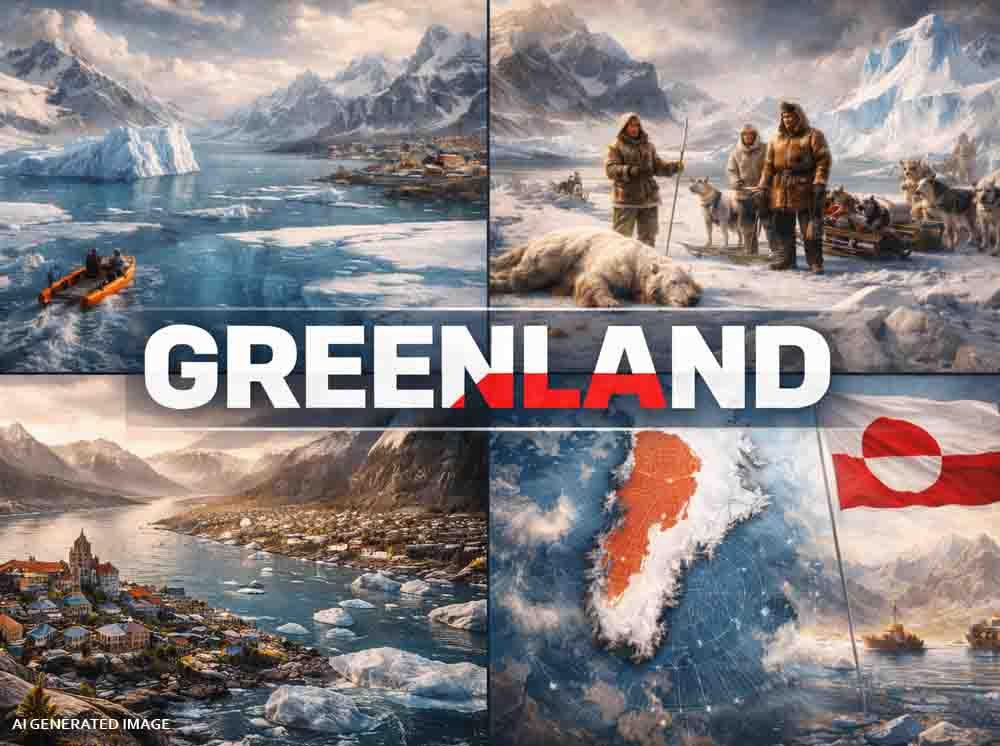
Greenland — or Kalaallit Nunaat in the Greenlandic language — is located between the Arctic and Atlantic oceans, northeast of Canada. It covers an area of roughly 2.17 million square kilometers, making it the world’s largest island not considered a continent. Despite this massive size, its population is small — about 56,500 people as of 2026. Source: Encyclopedia Britannica
Most of Greenland’s surface is covered by the Greenland ice sheet, a colossal body of ice up to 3 kilometers thick and second only to Antarctica in its volume. This ice profoundly shapes both the physical environment and global systems: its melting contributes directly to global sea-level rise and alters ocean currents. Recent studies show the ice sheet is cracking and changing at unprecedented rates, with rapidly expanding crevasses that intensify melting and could have far-reaching impacts on sea levels in the decades ahead. Source: The Guardian
The island’s interior is almost entirely uninhabitable ice, so settlements — including the capital Nuuk — hug the western and southern coasts, where the sea remains open longer each year due to warming temperatures.
Chapter 2: The Peoples and Cultures of Greenland
Greenland’s population is predominantly Inuit, known locally as Kalaallit in the west, with smaller groups such as Inughuit in the north and Tunumiit in the east. Greenlandic culture — deeply rooted in subsistence hunting, fishing, and living with the rhythms of the Arctic — persists even as modern influences grow. Source: Encyclopedia Britannica
The land and sea have historically been central to cultural identity. Traditional hunting of seals, whales, and polar bears shaped diets, social structures, and spiritual life. However, climate change is reshaping the natural world rapidly, threatening traditional practices and altering local ecosystems. Some hunters and elders describe a profound sense of loss as sea ice becomes thinner or less predictable, affecting not just economy but cultural survival. Source: The New Yorker
Chapter 3: A Brief History — From Norse Sagas to Inuit Homeland
Greenland’s human story extends back thousands of years. Several waves of Indigenous people settled the land long before Europeans arrived, adapting expertly to its harsh Arctic environment.
Norse Settlement and Early Contacts
In the late 10th century, Norse settlers led by Erik the Red established communities in southwestern Greenland. These lasted for several centuries before disappearing — likely due to climate cooling, isolation, and economic challenges.
Colonial Era and Danish Rule
Greenland’s colonial history began in earnest in 1721 when Danish-Norwegian missionary Hans Egede established a mission and trading post near modern-day Nuuk. This marked the start of extended Danish influence and eventual political control. Source: Encyclopedia Britannica
For much of the 18th–20th centuries, Greenland was governed as a colony of Denmark. In 1953, it was officially incorporated into the Danish realm as a county, offering Danish citizenship and representation in Denmark’s parliament. Source: Encyclopedia Britannica
During the Cold War, Greenland’s strategic location became important for NATO. The United States established a major base at Thule (now Pituffik Space Base) in the far north, displacing Indigenous residents in the process — a legacy that still resonates emotionally and politically today. Source: Encyclopedia Britannica The Washington Post
Chapter 4: Political Evolution — From Colony to Self-Rule
Home Rule and Self-Government
Greenland’s political development has been gradual but transformative:
- In 1979, Greenland gained Home Rule from Denmark, allowing self-governance on many domestic matters. Source: Encyclopedia Britannica
- In 2009, Greenland adopted the Self-Government Act, granting even greater autonomy — including control over most internal affairs and natural resources — and officially recognizing the Greenlandic people as a distinct people under international law. Source: csis.org
Under this arrangement, Denmark still controls foreign affairs, defense, and currency matters, and provides a significant annual financial subsidy that remains essential to Greenland’s economy. Source: csis.org
Chapter 5: Politics and Governance — Today’s Landscape
Greenland’s legislative body is the Inatsisartut, its unicameral parliament, with 31 seats. The government (known locally as Naalakkersuisut) is headed by a Premier.
In March 2025, a new government — the Nielsen cabinet — took office, representing a coalition of multiple parties and reflecting the island’s evolving and often complex political balance. Source: Wikipedia
Independence remains a key issue in Greenlandic politics. In 2025, general elections were strongly shaped by debates over independence and relationships with Denmark and external powers. Although independence has broad long-term support in principle, many Greenlanders are cautious about the economic realities of full sovereign statehood. Source: Wikipedia
Chapter 6: Greenland’s Strategic Importance Today
Global Geopolitics and the Arctic “Great Game”
Greenland sits at the heart of a reshaping Arctic geopolitical landscape. As Arctic ice retreats and opportunities for shipping, resource extraction, and strategic positioning emerge, global powers are paying closer attention.
In recent years, the United States — particularly under political figures like former President Donald Trump — has expressed interest in strengthening its role in Greenland, even floating proposals that drew criticism and diplomatic tension with Denmark and Europe. These discussions have been divisive, prompting protests in Denmark and Greenland and sparking broader debates about sovereignty and foreign influence. Source: The Guardian Financial Times
Russia’s foreign minister has weighed in on these debates, noting that Greenland is not a “natural part” of Denmark in historical terms, while disclaiming any intention to interfere, highlighting the global sensitivity of Arctic geopolitics. Source: Reuters
Meanwhile, Denmark has responded by bolstering military presence in Greenland with support from other European allies — a move framed as reinforcing security and autonomy amid external pressures. Source: New York Post
Chapter 7: Climate Change — The Melting Arctic
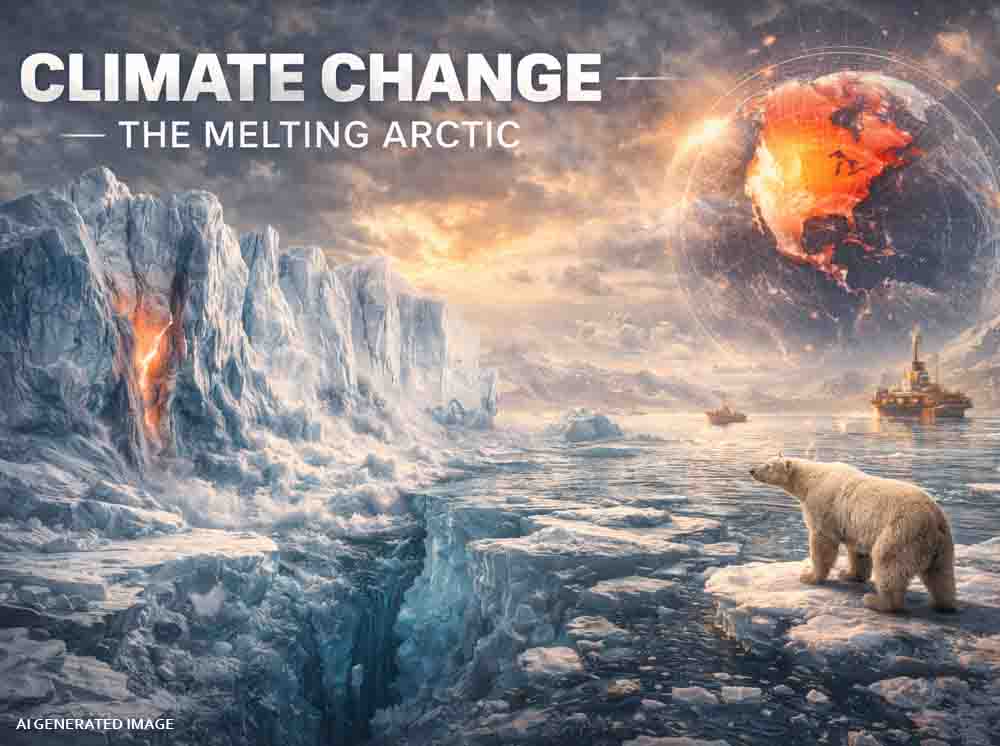
One of Greenland’s most dramatic roles in the world today is as a bellwether for climate change. The Greenland ice sheet is melting at record rates, contributing to global sea-level rise and altering weather patterns worldwide.
In addition to gradual melting, dramatic events like rockslides and tsunamis linked to glacial retreat highlight the accelerating impacts of warming temperatures. One such landslide in 2023 sent massive waves through Greenland’s fjords, demonstrating how climate change intensifies natural hazards. Source: Wikipedia
Scientists warn that continued ice sheet instability could contribute significantly to future global sea-level rise, with deep implications for coastal cities and communities worldwide. Source: The Guardian
For Greenlanders, climate change is a double-edged sword: it threatens traditional ways of life but also opens new economic and navigational opportunities — from expanded fisheries and tourism to Arctic shipping routes and resource exploration — all sparking complex discussions about development and sustainability. Source: Frontiers
Chapter 8: Economy and Society — Between Tradition and Modernity
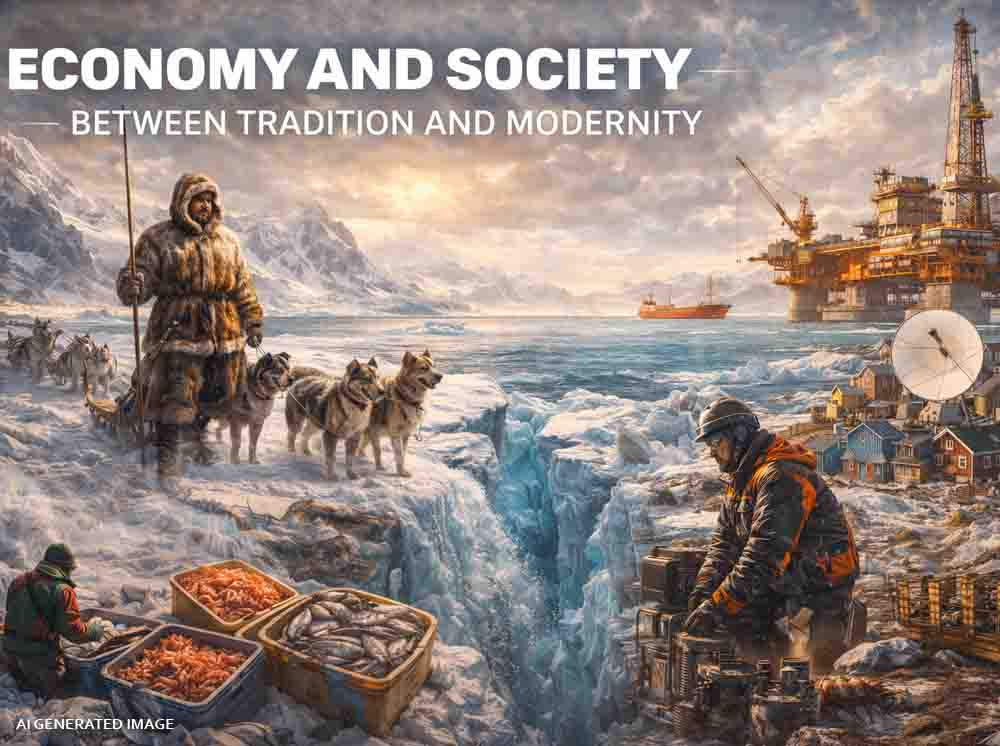
Greenland’s economy is small and heavily dependent on a few sectors:
- Fishing — especially shrimp — remains the backbone of exports and local economy.
- Annual subsidies from Denmark are essential, contributing roughly a third of Greenland’s GDP. csis.org
Even with its vast size and resource potential — including rare minerals and possibly hydrocarbons — economic diversification faces challenges from logistical constraints, small population size, and environmental concerns over resource extraction. Source: The Wall Street Journal
Socially, Greenland experiences rapid urbanization, with most people living in coastal towns like Nuuk. The blend of Inuit traditions and modern institutions creates a unique cultural synthesis, even as climate change and globalization present existential questions. Source: Scribd
Chapter 9: Looking Ahead — Independence and Identity
While Greenland’s autonomy continues to grow, full independence remains debated both politically and practically. Moving toward full sovereignty would require addressing significant challenges including economic sustainability, defense arrangements, and international recognition.
Most political discourse frames independence pragmatically — focusing on economic resilience and long-term viability rather than symbolic nationalism alone. Source: Maritime Education
At the same time, Greenland’s distinct identity — as a people with their own language, culture, and history — continues to fuel aspirations for greater control over their destiny.
Conclusion: Ice, Identity, and a Changing World
Greenland stands at an extraordinary crossroads:
- Its ice sheets are melting, reshaping global seas.
- Its people are asking who will truly govern their future.
- Its geopolitical position places it at the center of great power rivalries.
- Its culture continues to adapt and endure.
What was once considered an isolated island of ice now plays an outsized role in global affairs. How Greenland navigates climate change, autonomy, and international engagement in the decades ahead will shape not just Arctic futures, but the broader world’s political, environmental, and cultural landscapes.
Disclaimer
The information provided by Web Arbiter (‘we’, ‘us’, or ‘our’) on https://webarbiter.in/ . The website is for general informational purposes only. All information on the Site is provided in good faith, however we make no representation or warranty of any kind, express or implied, regarding the accuracy, adequacy, validity, reliability, availability, or completeness of any information on the Site. UNDER NO CIRCUMSTANCE SHALL WE HAVE ANY LIABILITY TO YOU FOR ANY LOSS OR DAMAGE OF ANY KIND INCURRED AS A RESULT OF THE USE OF THE SITE OR RELIANCE ON ANY INFORMATION PROVIDED ON THE SITE. YOUR USE OF THE SITE AND YOUR RELIANCE ON ANY INFORMATION ON THE SITE IS SOLELY AT YOUR OWN RISK. Read Full Disclaimer