

Prologue: While the Nation Rests
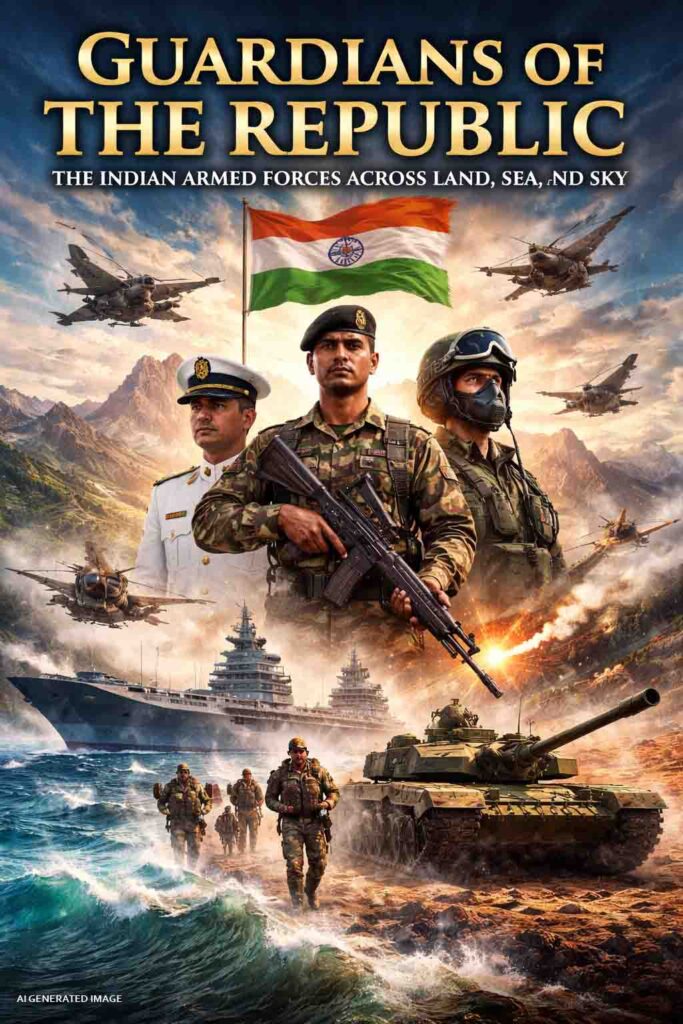
When most of the nation sleeps, somewhere on the icy ridges of Siachen a soldier adjusts his rifle against biting winds. Far below the surface of the Indian Ocean, a naval officer watches silent radar screens aboard a submarine gliding unseen. High above the clouds, an Indian Air Force pilot streaks through the sky at supersonic speed.
They serve in different terrains, under different commands, and in different dimensions, yet they share one unbreakable promise — to protect India’s sovereignty, unity, and people at any cost. This is the story of the Indian Armed Forces, a force shaped by history, sacrifice, and an unyielding sense of duty.
Chapter 1: Roots of a Martial Civilization
India’s military heritage predates modern nations. Ancient epics such as the Mahabharata and treatises like Kautilya’s Arthashastra describe disciplined armies, war ethics, intelligence networks, and naval power. Empires such as the Mauryas, Cholas, Rajputs, Marathas, and Sikhs built formidable military traditions long before the arrival of colonial powers.
The modern structure of India’s armed forces took shape during British rule. Indian soldiers fought across continents in the First and Second World Wars, earning global respect for bravery and professionalism. When India became independent in 1947, it inherited a trained but divided force, which it rapidly transformed into a national institution loyal to the Constitution rather than any ruler.
Chapter 2: A Professional Force in a Democratic Nation
The Indian Armed Forces operate under civilian control, with the President of India as Supreme Commander. Operational authority flows through the Chief of Defence Staff, integrating the Army, Navy, and Air Force for joint operations. This structure ensures unity of command while preserving the distinct strengths of each wing.
Unlike many militaries across history, the Indian Armed Forces remain firmly apolitical. Their loyalty lies not with governments or ideologies, but with the Republic and its people.
Chapter 3: The Indian Army — Guardians of the Land
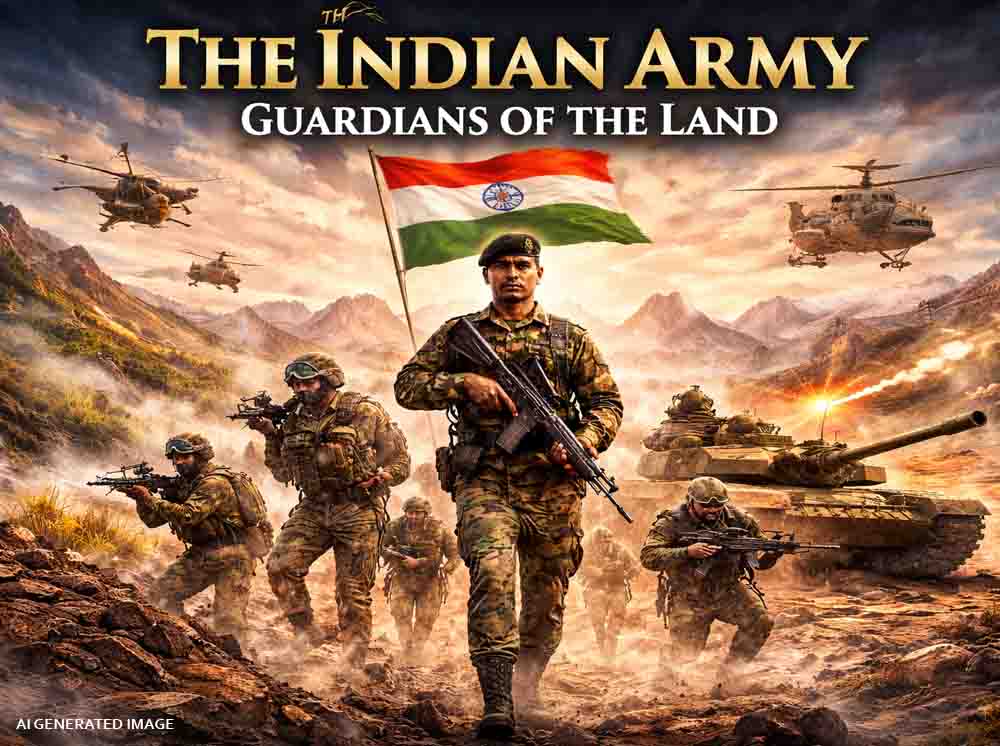
The Indian Army is the visible shield of the nation. Spread across deserts, jungles, mountains, plains, and glaciers, it is among the largest standing armies in the world. Indian soldiers guard some of the most challenging borders on Earth — from the frozen heights of Ladakh to the volatile Line of Control in Kashmir.
Since independence, the Army has fought multiple wars and countless counter-insurgency operations. From the first Kashmir conflict in 1947, to the wars of 1965 and 1971, and the Kargil conflict of 1999, the Army has repeatedly demonstrated resilience under fire. Beyond war, it has played a crucial role in disaster relief, peacekeeping missions, and internal security operations.
What defines the Indian Army is not only its battlefield success but its connection to the people. Soldiers frequently serve among civilians, building trust while countering threats. The Army’s motto, “Service Before Self,” reflects a culture where duty outweighs personal comfort.
Motto: “Service Before Self”
Strength: Over 1.2 million active personnel
The Indian Army is the backbone of national defense. It operates across some of the harshest terrains on Earth — deserts of Rajasthan, jungles of the Northeast, glaciers of Ladakh, and mountains of Kashmir.
Roles & Responsibilities
- Defending land borders
- Counter-terrorism operations
- Counter-insurgency
- Disaster relief and humanitarian missions
- Peacekeeping operations under the UN
Major Commands
- Northern Command
- Western Command
- Eastern Command
- Southern Command
- Central Command
- South Western Command
- Army Training Command (ARTRAC)
Historic Wars & Operations
- 1947–48: First Kashmir War
- 1962: Sino-Indian War
- 1965 & 1971: Indo-Pak Wars
- 1999: Kargil War
- 2016 & 2019: Surgical Strikes & Balakot Air Strikes (joint operations)
- 2025: Operation Sindoor
The Indian Army is known not just for fighting wars, but for winning hearts and minds, especially in conflict zones.
Elite Forces of the Indian Army
Para Special Forces (Para SF)
India’s most feared commandos, trained in:
- Deep penetration strikes
- Counter-terrorism
- Hostage rescue
- Jungle, desert, mountain, and urban warfare
Gorkha Regiments
Famous for their courage and the traditional Khukri knife, Gorkha soldiers are symbols of loyalty and valor.
Mechanized & Armoured Corps
With tanks like Arjun and T-90 Bhishma, India maintains one of the world’s strongest armored forces.
Chapter 4: Courage Beyond the Call
Within the Army exist elite units trained for the most dangerous missions. Special Forces conduct deep-penetration raids, hostage rescues, and counter-terrorism operations, often operating behind enemy lines. Infantry regiments such as the Gorkhas, Rajputs, and Sikh regiments carry centuries-old traditions of valor.
Armoured and mechanized units form the steel backbone of land warfare, operating tanks and artillery systems that can dominate the battlefield in conventional war. Engineers, medics, and logistics units ensure that even in extreme conditions, soldiers remain supplied, connected, and combat-ready.
Chapter 5: The Indian Navy — Guardians of the Seas
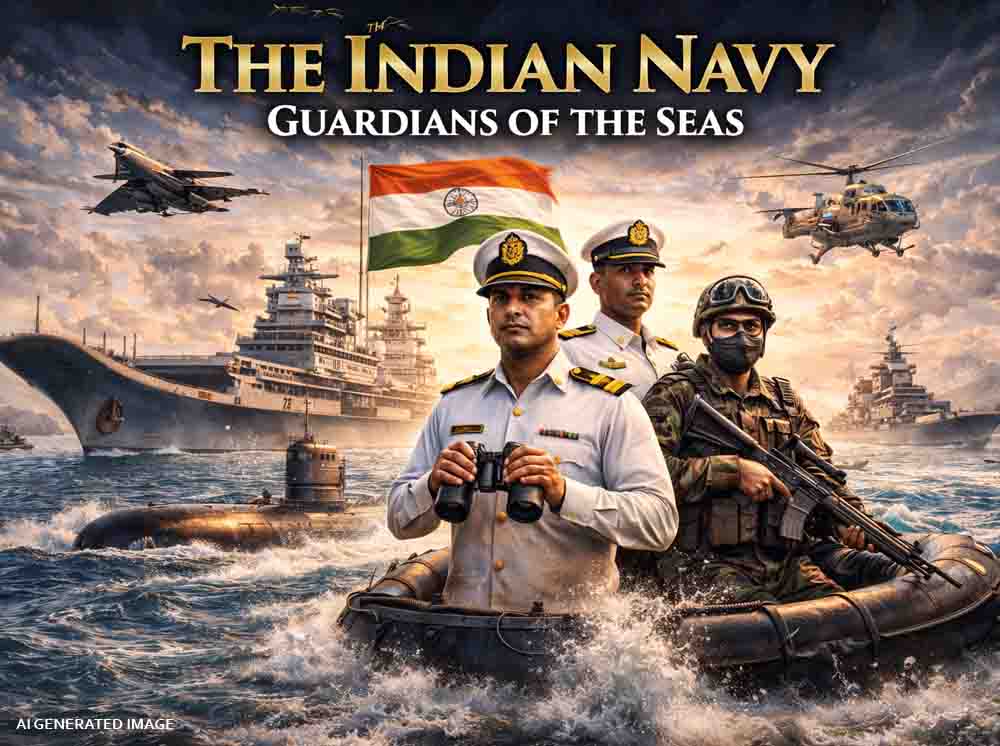
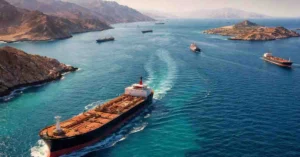
India’s maritime destiny is inseparable from the Indian Ocean. Nearly all of India’s trade and energy supplies move by sea, making naval security essential to national survival. The Indian Navy safeguards vast maritime routes stretching from the Persian Gulf to the Strait of Malacca.
Modern India’s Navy has evolved into a blue-water force capable of operating far beyond its shores. Aircraft carriers, destroyers, submarines, and surveillance aircraft give India the ability to project power and protect maritime interests. Nuclear-powered submarines form the silent core of India’s strategic deterrence.
The Navy has earned global respect through anti-piracy patrols, humanitarian assistance, and evacuation missions during crises. Whether rescuing citizens from war zones or delivering aid after natural disasters, Indian naval ships often serve as the nation’s first responders at sea.
Motto: “Sham No Varunah”
Role: Maritime dominance and sea-based deterrence
India’s geographic position makes the Indian Ocean Region (IOR) strategically vital. The Indian Navy ensures:
- Protection of sea lanes
- Maritime trade security
- Deterrence against naval threats
- Power projection beyond borders
Fleet Composition
- Aircraft carriers (INS Vikrant, INS Vikramaditya)
- Destroyers and frigates
- Nuclear-powered submarines (Arihant-class)
- Patrol vessels and amphibious ships
Naval Aviation
Includes:
- Carrier-based fighter jets
- Maritime patrol aircraft
- Helicopters for ASW (Anti-Submarine Warfare)
Strategic Importance
The Indian Navy plays a key role in:
- Anti-piracy missions
- Evacuations (Operation Rahat, Operation Samudra Setu)
- Humanitarian assistance during tsunamis and cyclones
Chapter 6: The Indian Air Force — Mastery of the Skies
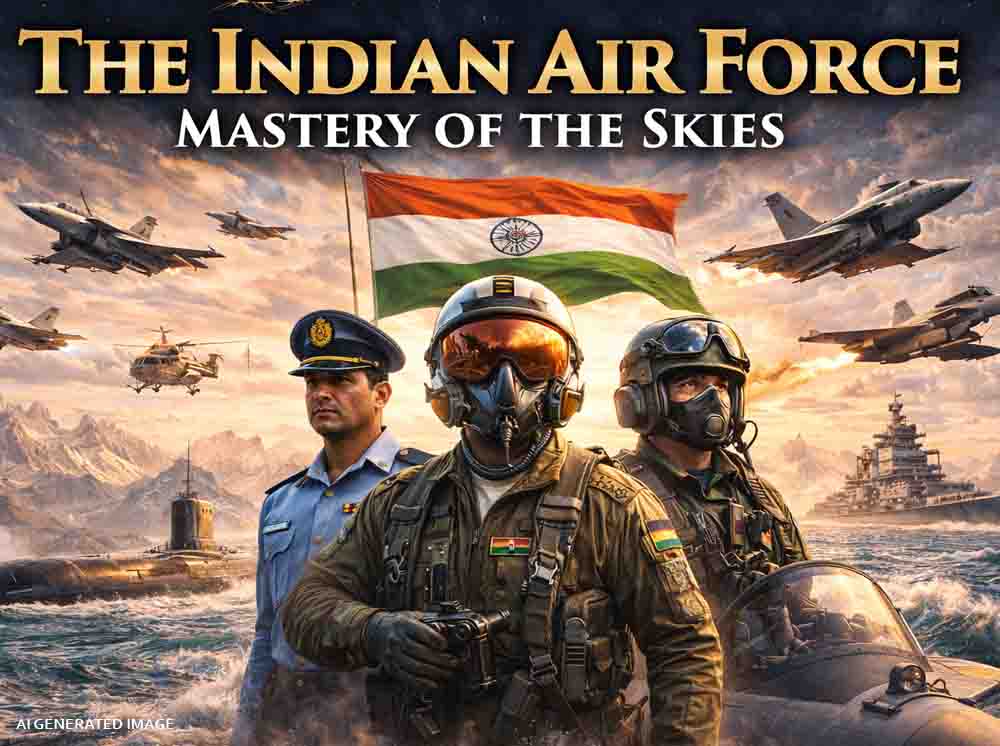
If the Army holds the ground and the Navy guards the seas, the Indian Air Force commands the skies. Speed, precision, and reach define its power. In modern warfare, air superiority often determines victory, and the IAF has proven its capability time and again.
From high-altitude strikes to strategic airlift operations, the Air Force enables rapid response across India’s vast geography. Fighter jets, transport aircraft, helicopters, and surveillance systems allow the IAF to strike deep, defend swiftly, and deliver aid where roads cannot reach.
The Air Force has played decisive roles in wars, counter-terrorism operations, and humanitarian missions. Its pilots train relentlessly, knowing that every mission demands split-second decisions with life-or-death consequences.
Motto: “Nabha Sparsham Deeptam”
The Indian Air Force (IAF) is among the world’s most formidable air forces, capable of:
- Air superiority
- Precision strikes
- Strategic airlift
- Intelligence, surveillance, and reconnaissance (ISR)
Combat Fleet
- Rafale
- Su-30 MKI
- Mirage 2000
- Tejas (LCA – Indigenous fighter)
- MiG series (being phased out)
Strategic Assets
- AWACS
- Mid-air refueling aircraft
- Transport planes like C-17 Globemaster and C-130J
The IAF has proven its capability in wars, surgical strikes, and humanitarian missions — delivering aid to the most inaccessible locations.
Chapter 7: Joint Power and Strategic Deterrence
Modern conflict does not respect boundaries between land, sea, and air. India’s military doctrine increasingly emphasizes jointness, ensuring that all three services operate as a unified force.
India maintains credible deterrence to prevent conflict rather than invite it. Strategic capabilities exist to ensure that national sovereignty is never threatened. The goal is stability, not aggression.
Through diplomacy, preparedness, and restraint, the Indian Armed Forces aim to secure peace by being ready for war.
Chapter 8: Nuclear Deterrence & Strategic Forces
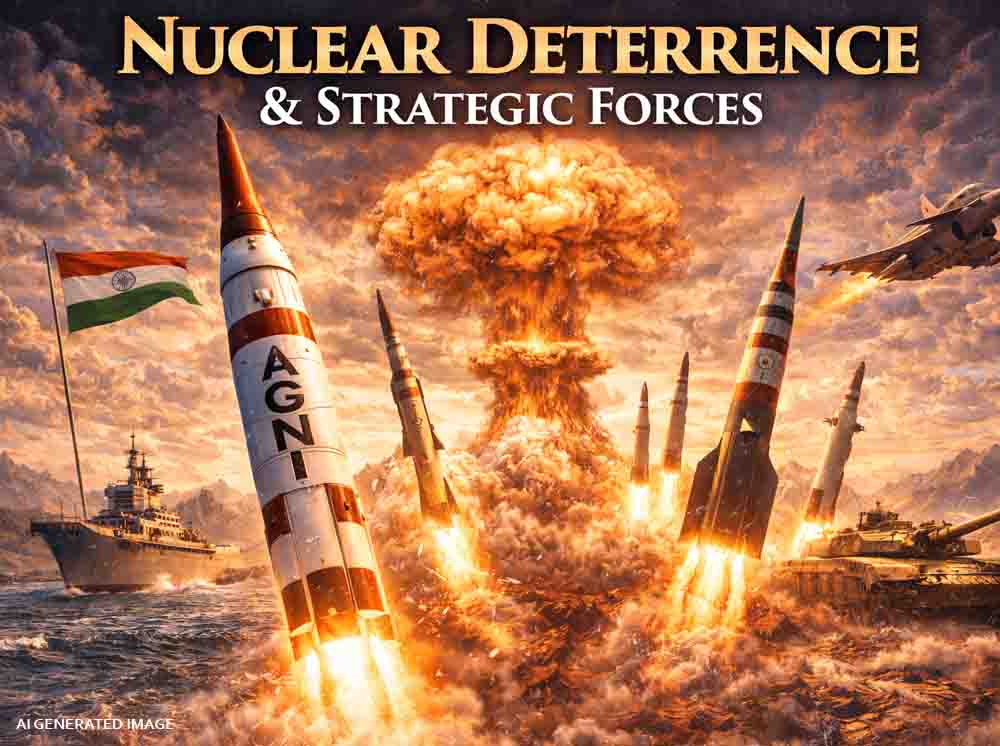
India follows a “No First Use” nuclear doctrine, maintaining a credible minimum deterrence.
Strategic Forces Command
Controls:
- Land-based missiles (Agni series)
- Sea-based nuclear submarines
- Air-delivered nuclear weapons
This triad ensures that India’s sovereignty is protected against existential threats.
Chapter 9: Paramilitary and Supporting Forces
India’s internal security and border management framework is strengthened by a robust network of paramilitary and supporting forces that function as a crucial link between civilian law enforcement and the armed forces. These organizations are designed to handle complex security challenges that fall short of full-scale military conflict but exceed the capacity of regular police forces. Collectively, they ensure territorial integrity, internal stability, and the protection of strategic assets across the country. Among the most prominent of these forces are the Border Security Force (BSF), Central Reserve Police Force (CRPF), Indo-Tibetan Border Police (ITBP), Central Industrial Security Force (CISF), and Assam Rifles, each entrusted with specialized responsibilities aligned with India’s diverse security needs.
The Border Security Force (BSF) is India’s primary force for guarding international borders during peacetime, particularly along the borders with Pakistan and Bangladesh. It plays a critical role in preventing illegal infiltration, cross-border crime, smuggling, and hostile incursions, while also supporting the army during wartime. The BSF is often described as the first line of defense and is actively involved in border management, surveillance, and humanitarian assistance during natural disasters in border regions. Complementing this role is the Indo-Tibetan Border Police (ITBP), which is responsible for securing the high-altitude and extremely challenging Himalayan borders with China. Operating in some of the world’s harshest terrains and climatic conditions, the ITBP not only maintains border vigilance but also undertakes mountain rescue operations, disaster response, and environmental protection duties, reflecting its multifaceted role in national security.
The Central Reserve Police Force (CRPF) serves as the backbone of India’s internal security apparatus. It is primarily deployed to maintain law and order, conduct counter-insurgency and anti-terrorist operations, and assist state police forces during elections and major internal disturbances. The CRPF has been at the forefront of combating left-wing extremism and insurgency in several regions, showcasing its adaptability and operational depth. Its specialized units enhance its effectiveness in handling riots, terrorism, and high-risk security scenarios. In contrast, the Central Industrial Security Force (CISF) is tasked with safeguarding critical infrastructure and strategic installations that are vital to the nation’s economic and security interests. This includes airports, seaports, nuclear power plants, government buildings, and major public sector enterprises. By ensuring the uninterrupted functioning of these assets, the CISF plays a vital role in national development and economic stability.
The Assam Rifles, one of the oldest paramilitary forces in the country, holds a unique position in India’s security landscape, particularly in the Northeast region. It performs a dual role of maintaining internal security and guarding international borders, especially along the India–Myanmar frontier. Deeply familiar with the local terrain and socio-cultural dynamics, the Assam Rifles is instrumental in counter-insurgency operations and in fostering trust and cooperation with local communities. Together, these paramilitary and supporting forces form an integrated security mechanism that bridges the gap between internal policing and military operations, enabling India to respond effectively to a wide spectrum of traditional and non-traditional security challenges.
Chapter 10: Indigenous Defence and India’s Global Peacekeeping Role
India’s defence strategy is evolving rapidly as the country moves from being one of the world’s largest arms importers toward becoming a self-reliant defence manufacturing hub. Through the Make in India and Atmanirbhar Bharat initiatives, India aims to strengthen national security, reduce foreign dependence, and achieve greater strategic autonomy. Indigenous defence production has become a cornerstone of this transformation, supported by growing technological capability and industrial capacity.
Several key indigenous projects highlight this shift. The Tejas Light Combat Aircraft enhances the Indian Air Force’s combat readiness while showcasing domestic aerospace engineering. The Arjun Main Battle Tank represents advances in indigenous armored warfare technology, while INS Vikrant, India’s first indigenously built aircraft carrier, marks a major milestone in naval self-reliance. In missile technology, the Akash air defence system provides a reliable, homegrown solution to modern aerial threats. At the same time, India is investing heavily in drones, artificial intelligence, and next-generation warfare tools, reflecting preparedness for future battlefields dominated by technology and automation. Together, these initiatives strengthen defence capability, support domestic industry, and enhance long-term strategic independence.
Alongside its indigenous defence push, India plays a significant role in promoting global peace and security. The country is one of the largest contributors to United Nations peacekeeping missions, with deployments across Africa, the Middle East, and Southeast Asia. Indian peacekeepers are widely respected for their professionalism, discipline, and humanitarian approach, often engaging in civilian protection, medical assistance, and infrastructure support in conflict-affected regions.
By combining self-reliant defence manufacturing with an active global peacekeeping role, India demonstrates a balanced security vision. This approach not only safeguards national interests but also reinforces India’s image as a responsible and credible contributor to international peace and stability.
Chapter 11: Women in Uniform
The presence of women in the Indian Armed Forces marks a profound transformation. From fighter pilots to naval commanders and army officers, women now serve in roles once considered unreachable. Their inclusion strengthens operational capability and reflects a changing society that recognizes merit above tradition.
Chapter 12: Self-Reliance and the Future of Defence
India is transitioning from a major arms importer to a growing defense manufacturer. Indigenous aircraft, warships, missiles, and electronic warfare systems are reshaping military preparedness. This push for self-reliance not only strengthens security but ensures strategic independence in an uncertain world.
Chapter 13: Beyond the Battlefield
The Indian Armed Forces are not only instruments of war. They are first responders during floods, earthquakes, pandemics, and national emergencies. Soldiers often risk their lives to save civilians, reinforcing the bond between the military and society.
Behind every uniform stands a family that shares the burden of service. Sacrifice extends far beyond the battlefield, into homes where loved ones wait, worry, and endure in silence.
Conclusion: More Than a Military
The Indian Armed Forces are not just defenders of borders — they are defenders of democracy, dignity, and disaster relief, standing tall in moments of war and peace alike.
From the icy heights to the deepest seas, from silent submarines to roaring fighter jets, India sleeps safely because its soldiers do not.
They are not just warriors.
They are the guardians of the Republic.
Disclaimer
The information provided by Web Arbiter (‘we’, ‘us’, or ‘our’) on https://webarbiter.in/ . The website is for general informational purposes only. All information on the Site is provided in good faith, however we make no representation or warranty of any kind, express or implied, regarding the accuracy, adequacy, validity, reliability, availability, or completeness of any information on the Site. UNDER NO CIRCUMSTANCE SHALL WE HAVE ANY LIABILITY TO YOU FOR ANY LOSS OR DAMAGE OF ANY KIND INCURRED AS A RESULT OF THE USE OF THE SITE OR RELIANCE ON ANY INFORMATION PROVIDED ON THE SITE. YOUR USE OF THE SITE AND YOUR RELIANCE ON ANY INFORMATION ON THE SITE IS SOLELY AT YOUR OWN RISK. Read Full Disclaimer