

In the long and turbulent history of India, few names shine as brightly as Maharana Pratap—a warrior king who chose hardship over surrender, honor over comfort, and freedom over submission.
Prologue: A King Who Refused to Kneel
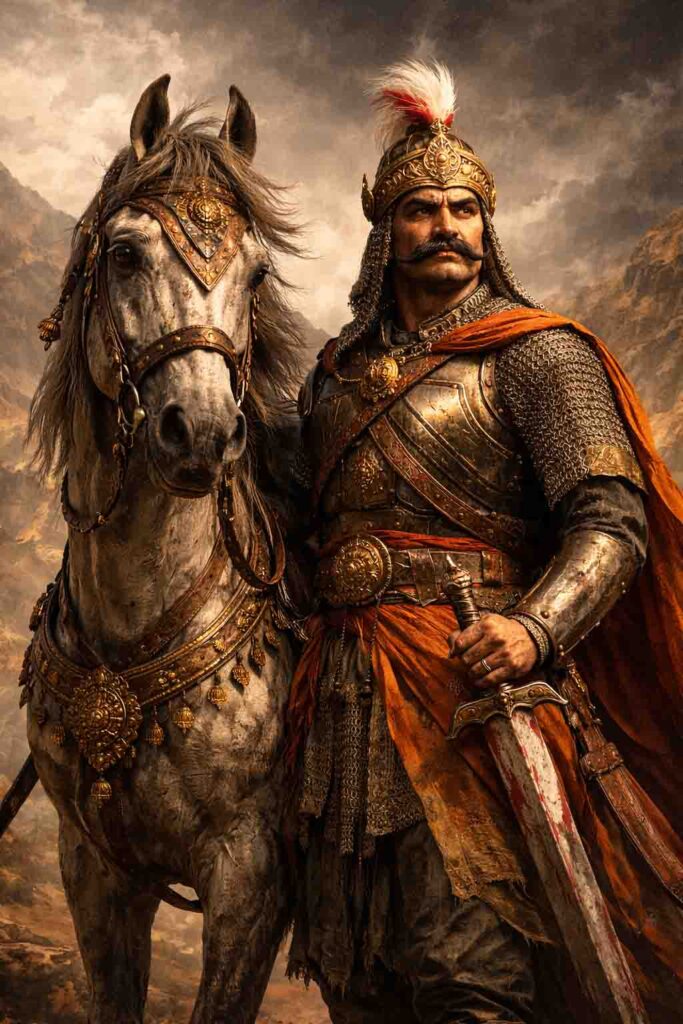
History often celebrates those who built empires through conquest. But true history bows its head before those who refused to surrender their soul.
In the 16th century, as the Mughal Empire expanded relentlessly across the Indian subcontinent, crushing kingdoms and absorbing rulers into its vast machinery of power, one land stood unbroken. This land was Mewar, and its guardian was a warrior whose name became synonymous with freedom—Maharana Pratap.
He did not rule from marble palaces adorned with gold. He ruled from the rocky hills, dense forests, and the unyielding spirit of his people. His life was not one of luxury but of sacrifice. His crown was heavy, not with jewels, but with responsibility.
Maharana Pratap was not merely a king. He was a vow—to never bow before injustice, no matter the cost.
Chapter 1: The Sacred Land of Mewar
Mewar was not just a kingdom; it was an idea. Surrounded by the Aravalli mountain range, it had long been a symbol of Rajput pride, sacrifice, and independence. The soil of Mewar was soaked with the blood of warriors who had chosen death over dishonor.
The Sisodia dynasty, rulers of Mewar, traced their lineage back to Bappa Rawal, who had defended India from early invasions centuries before. Chittorgarh, the great fortress of Mewar, stood as a silent witness to countless acts of heroism and jauhar.
This was the land into which Maharana Pratap was born—a land where freedom was inherited like blood, and surrender was considered worse than death.
Chapter 2: Birth of Destiny
On 9 May 1540, inside the mighty Kumbhalgarh Fort, a son was born to Maharana Udai Singh II and Rani Jaiwanta Bai. He was named Pratap Singh.
From the moment of his birth, elders sensed that this child carried a rare destiny. He was raised not merely as a prince, but as a future guardian of Mewar’s honor.
Rani Jaiwanta Bai played a crucial role in shaping his character. She taught him that a king’s duty was not to rule, but to protect—to stand as the first shield between his people and danger.
Stories of fallen ancestors, of heroic resistance, and of sacrifices made for dharma filled Pratap’s childhood. These were not bedtime tales; they were lessons engraved into his soul.
Chapter 3: Forged in Strength and Discipline
Pratap’s youth was marked by rigorous training. While other princes enjoyed courtly pleasures, Pratap spent his days mastering weapons and his nights strengthening his resolve.
He trained in:
- Sword fighting and spear combat
- Archery under harsh conditions
- Horse riding across treacherous terrain
- Survival in forests and mountains
He grew into a physically imposing figure—tall, powerfully built, and fearless. His armor was said to weigh over 70 kilograms, a testament to his extraordinary strength.
Yet, his greatest strength lay in his character. Pratap believed deeply in Rajput dharma—honor, loyalty, courage, and sacrifice. For him, kingship was service, not entitlement.
Chapter 4: The Crown of Responsibility
In 1572, Maharana Udai Singh II passed away. Amid uncertainty and internal court politics, Pratap ascended the throne as Maharana Pratap of Mewar.
He inherited a kingdom under immense pressure. The Mughal Empire, under Emperor Akbar, had become the most powerful force in India. Kingdom after kingdom had submitted—some willingly, others through fear.
Akbar was not merely a conqueror; he was a strategist. He preferred diplomacy before war and offered alliances, ranks, and wealth to Rajput rulers.
But Mewar was different. And so was its ruler.
Chapter 5: The Offer of Submission
Akbar sent repeated diplomatic missions to Maharana Pratap. The messages were polite but clear—accept Mughal supremacy, retain your kingdom, and live in peace.
For many rulers, this was a practical choice. For Maharana Pratap, it was unacceptable.
Submission meant acknowledging foreign authority over Mewar. It meant breaking the sacred oath of his ancestors.
With calm resolve, Maharana Pratap refused every offer. His words carried the weight of centuries:
“Mewar will remain free as long as there is one Sisodia.”
This refusal was not rebellion. It was a declaration of independence.
Chapter 6: The Storm Gathers
Akbar realized that Mewar could not be won through diplomacy. War became inevitable.
Mughal armies advanced toward the borders of Mewar. Forts were surrounded. Trade routes were cut. Pressure mounted on every side.
Maharana Pratap prepared for a battle he knew would be unequal. He did not have Akbar’s numbers or resources—but he had something stronger: the will to resist.
Chapter 7: The Battle of Haldighati
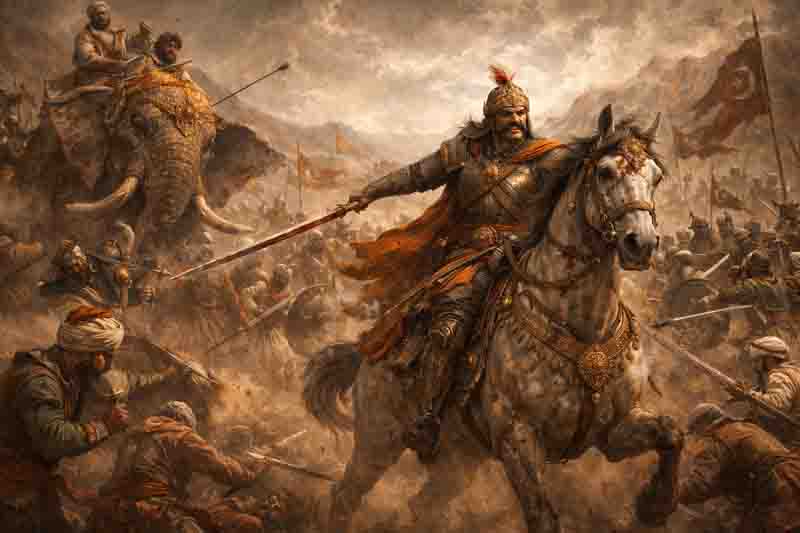
On 18 June 1576, history stood still at a narrow mountain pass called Haldighati, named after its yellow-colored soil.
The Opposing Forces
- Mewar Army: Around 20,000 soldiers
- Mughal Army: Over 80,000 soldiers, led by Man Singh of Amber
The battlefield echoed with war cries, clashing steel, and the thunder of horses.
Maharana Pratap rode into battle on his legendary horse Chetak, a symbol of loyalty and bravery. With a spear in hand, he charged directly toward Man Singh, displaying fearless leadership.
The battle was brutal and chaotic. Rajput warriors fought with unmatched courage, knowing they were outnumbered but unbroken.
Chapter 8: The Sacrifice of Chetak
During the battle, Chetak was gravely wounded. One of his legs was severed, yet he continued to run, driven by loyalty to his master.
In a final act of devotion, Chetak carried Maharana Pratap across a stream to safety. Only after ensuring his king’s survival did he collapse and die.
Chetak’s sacrifice became immortal—a reminder that courage is not limited to humans alone.
Chapter 9: After the Battle
Militarily, the Battle of Haldighati did not give the Mughals complete victory. Maharana Pratap was not captured, nor was Mewar fully conquered.
However, Pratap lost control of major forts and cities. His kingdom was pushed into the wilderness.
The war had entered a new phase.
Chapter 10: A King in the Forest
What followed was the most painful chapter of Maharana Pratap’s life.
He used to rule over palaces, but now he lived in jungles. His family endured hunger. They survived on wild fruits, roots, and bread made from grass.
There are stories of Pratap watching his children cry from hunger, tears silently flowing down his face. Yet even in those moments, surrender never crossed his mind.
His suffering was not weakness. It was resistance in its purest form.
Chapter 11: Loyalty That Saved a Kingdom
During this dark period, loyal supporters stood by Maharana Pratap. The most notable among them was Bhamashah, his devoted minister.
Bhamashah donated his entire personal wealth to Pratap’s cause. This act revived the struggle for Mewar.
With renewed strength, Pratap reorganized his forces and adopted guerrilla warfare tactics.
Chapter 12: The War of Shadows
Instead of open battles, Maharana Pratap attacked swiftly and disappeared into the mountains. His soldiers knew the terrain intimately.
Mughal supply lines were disrupted. Outposts were attacked unexpectedly. The empire’s massive army found itself powerless against a king who fought like the land itself.
One by one, regions of Mewar were reclaimed.
Chapter 13: Reclaiming Mewar
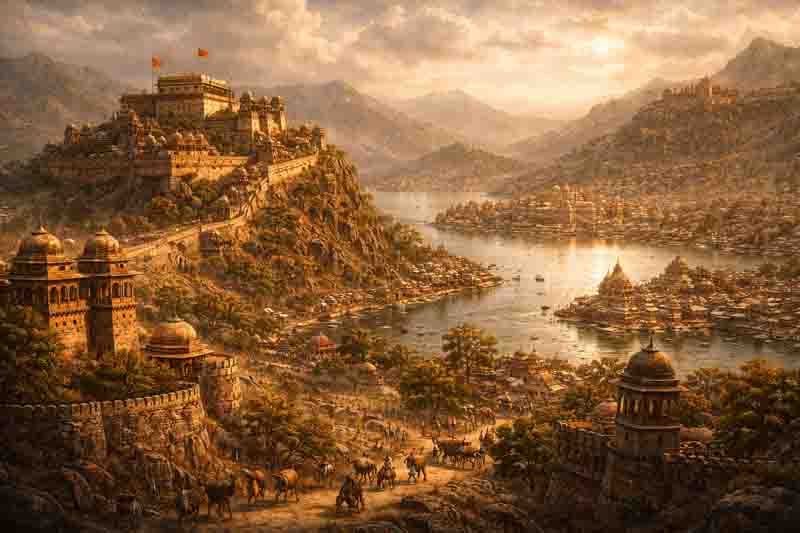
By the late 1580s, Maharana Pratap had regained control over most of western and central Mewar, including Kumbhalgarh.
Chittorgarh remained under Mughal control, but Mewar’s spirit was alive.
Akbar himself eventually withdrew focus from Mewar, recognizing that this was a land that refused to be tamed.
Chapter 14: The Final Years
Years of hardship and continuous warfare took a toll on Maharana Pratap’s body.
In 1597, he suffered fatal injuries during a hunting accident. As he lay on his final bed, he called his son Amar Singh I and made him promise never to surrender Mewar’s independence.
That promise was kept.
Epilogue: Immortality Beyond Victory
Maharana Pratap died at the age of 56, but his legacy grew stronger with time.
He never built an empire—but he built a legacy of courage. He lost battles—but he won the war of conscience.
Even Akbar is believed to have admired him, acknowledging that Maharana Pratap was a king who could not be broken.
Today, Maharana Pratap stands as:
- A symbol of fearless resistance
- A reminder that freedom has a price
- An eternal inspiration for generations
He was not defeated.
He was not conquered.
He lived free.
And in history, he remains immortal.
Disclaimer
The information provided by Web Arbiter (‘we’, ‘us’, or ‘our’) on https://webarbiter.in/ . The website is for general informational purposes only. All information on the Site is provided in good faith, however we make no representation or warranty of any kind, express or implied, regarding the accuracy, adequacy, validity, reliability, availability, or completeness of any information on the Site. UNDER NO CIRCUMSTANCE SHALL WE HAVE ANY LIABILITY TO YOU FOR ANY LOSS OR DAMAGE OF ANY KIND INCURRED AS A RESULT OF THE USE OF THE SITE OR RELIANCE ON ANY INFORMATION PROVIDED ON THE SITE. YOUR USE OF THE SITE AND YOUR RELIANCE ON ANY INFORMATION ON THE SITE IS SOLELY AT YOUR OWN RISK. Read Full Disclaimer