


Prologue: The Unconquered Spirit
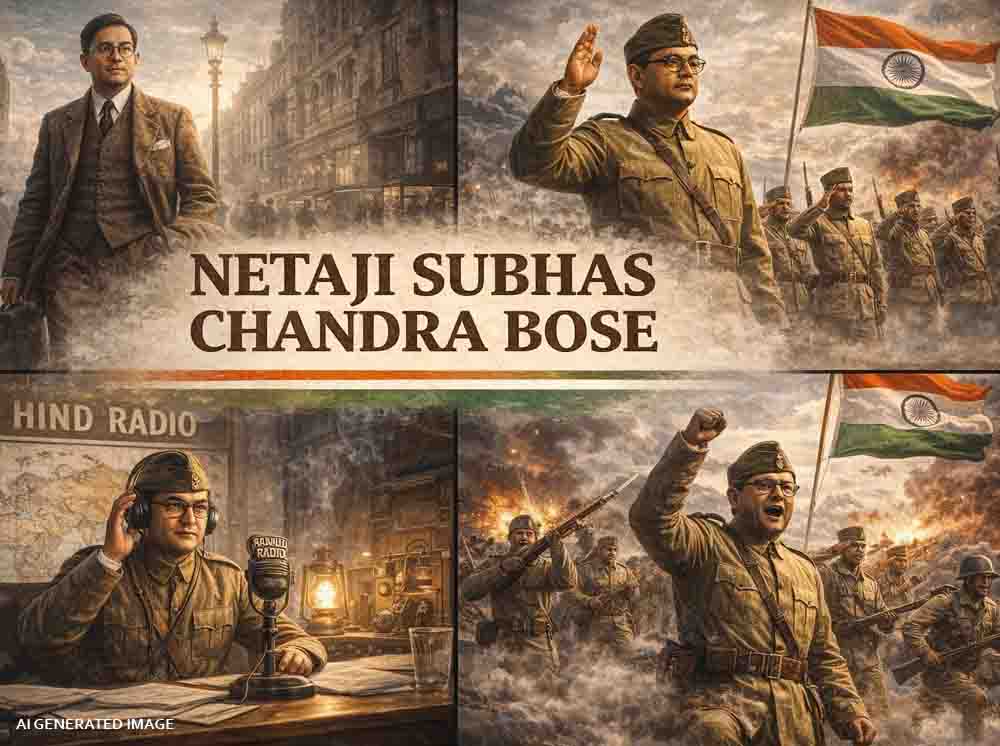
When we speak of India’s long struggle against British colonialism, one name shines with fierce resolve, strategic audacity, and unwavering patriotism — Subhas Chandra Bose, popularly known as Netaji (“Respected Leader”). In contrast to many of his contemporaries who advocated for nonviolence as the primary means of resistance, Bose took a drastically different approach, using military conflict, unwavering opposition, and international alliances to free himself from the British Empire. His life story is a tale of bravery, controversy, conviction, and enduring legend rather than merely a chapter in India’s freedom movement.
Chapter 1: Early Life — Forming the Firebrand
Subhas Chandra Bose was born in Cuttack, Odisha, on January 23, 1897, into a wealthy Bengali family. His father, Janakinath Bose, was a successful lawyer, and his mother, Prabhavati Devi, nurtured his moral spirit from an early age. Bose grew up in an environment that prized education, discipline, and patriotic ideals. Because of this upbringing, he developed a strong sense of duty toward his country early in life. Source: Encyclopedia Britannica
He was a brilliant student and entered Presidency College, Calcutta (now Kolkata). However, even as a young man, Bose showed signs of defiance against injustice; he was expelled from the college in 1916 for protesting against British policies. He completed his education at Scottish Church College, graduating in 1919. Later, he travelled to England to prepare for the Indian Civil Service (ICS) — the elite administrative service of British India. Although he passed the examination in 1920, he abandoned his ICS career to return to India and join the freedom struggle, a choice that defined his life. Source: Encyclopedia Britannica
Chapter 2: Early Political Career and Ideological Foundations
Upon returning to India, Bose joined the Indian National Congress (INC) — the primary political party leading the independence movement. Initially, he worked closely with leaders like Mahatma Gandhi, Jawaharlal Nehru, Chittaranjan Das, and others, gaining prominence for his organizational skills, fiery speeches, and relentless energy. Source: Encyclopedia Britannica
Bose quickly rose through the ranks. He became the Chief Executive Officer of the Calcutta Municipal Corporation under Mayor Chittaranjan Das in 1924 and served as a key leader in different Congress activities. However, his political philosophy began to diverge sharply from that of Gandhi and other senior leaders: while Gandhi championed non-violent resistance (Ahimsa), Bose believed that freedom must be won by force if necessary. This ideological split would later become the defining divide in his political path. Source: Encyclopedia Britannica
Chapter 3: Clash with Mahatma Gandhi and Rise in the Congress
In the 1930s, Bose’s radical approach started to set him apart within the Congress. He criticized the dominant Gandhian ideology as being too conservative and passive in the face of British oppression — a view that resonated with younger activists and revolutionaries who were impatient for results. His clashes with Gandhi were both personal and political, though he always maintained respect for Gandhi’s stature as the moral leader of the movement. Source: Encyclopedia Britannica
Bose was elected as President of the Indian National Congress twice, first in 1938 and again in 1939. During his presidency, he pushed for complete independence (Purna Swaraj) — a position that challenged moderates within the party who were willing to consider Dominion status as an intermediate goal. His tenure also saw the formation of a National Planning Committee, which proposed ambitious economic reforms and industrial growth plans — ideas that were not entirely compatible with Gandhi’s emphasis on village industries. Source: Encyclopedia Britannica
However, his leadership period was turbulent. Tensions within the Congress peaked, and after disputes with Gandhi’s faction, Bose resigned in 1939. Shortly afterwards, he founded the Forward Bloc, aiming to unite all radical elements under one banner. But British authorities viewed his activism as a threat and soon imprisoned him in 1940. Facing severe restrictions, Bose threatened a hunger strike that would have led to his death in custody, forcing the British to release him. Source: Encyclopedia Britannica
Chapter 4: Escape from India — A Path of Strategy and Risk
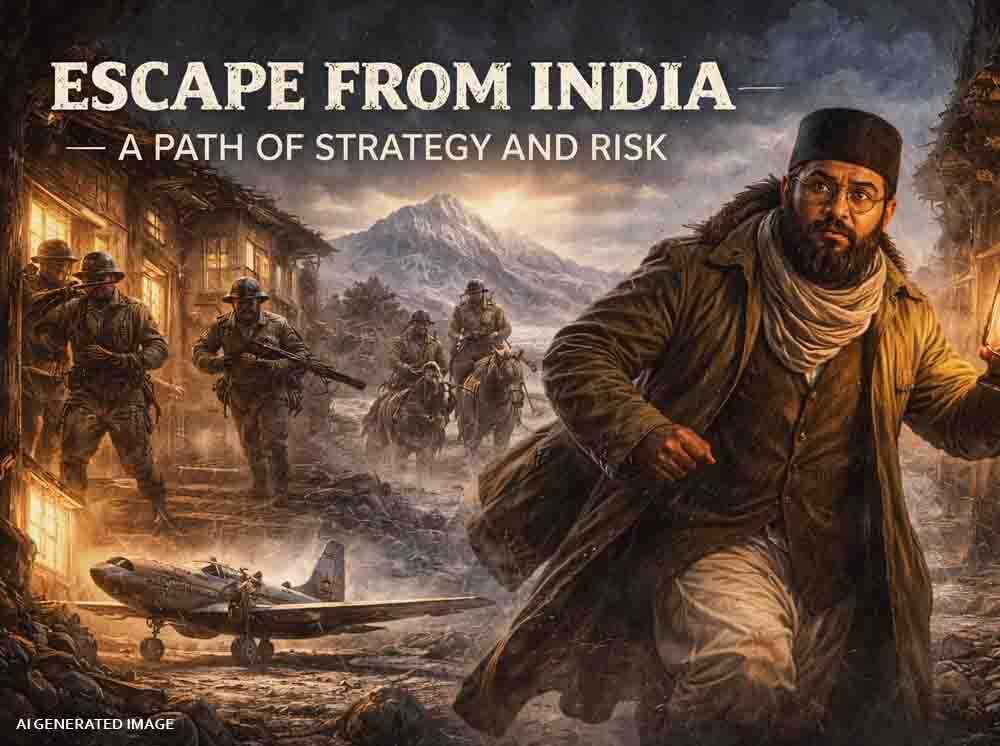
By early 1941, British surveillance on Bose had tightened. Facing relentless confinement, Bose decided on a daring escape. On January 26, 1941, disguised as an Afghan named Muhammad Ziauddin, he fled his house in Calcutta and embarked on a perilous journey through Afghanistan, then to the Soviet Union, and finally to Germany in April 1941. Source: Encyclopedia Britannica
His decision was radical: he sought to leverage the global conflict of World War II to India’s advantage. Bose believed that the British could be defeated as part of the wider war against the Axis powers — Germany, Italy, and Japan. In Germany, Bose set up the Free India Centre and the Indian Legion (composed mainly of Indian prisoners of war) to mobilize Indian resistance from abroad. His broadcasts from Berlin aimed to inspire Indians and undermine British authority, and he also established the Azad Hind Radio to advocate Indian independence in multiple languages. Source: Encyclopedia Britannica Wikipedia
Chapter 5: The Indian National Army and the Azad Hind Government
By 1943, Bose shifted his focus from Europe to Asia. Travelling through German and Japanese routes, he reached Japanese-occupied Southeast Asia and took leadership of the Indian National Army (INA) — originally formed by Rash Behari Bose and others, but reinvigorated under Subhas Chandra Bose’s leadership. Source: Indiatimes
Under Bose’s guidance, the INA grew to include tens of thousands of soldiers, many of whom were Indian prisoners of war and expatriates driven by a shared desire for independence. The INA became the military arm of the Azad Hind Government (Provisional Government of Free India), which Bose formally declared on October 21, 1943 — raising the Indian flag on foreign soil for the first time since colonial rule began. Source: Indiatimes
The INA fought alongside Japanese forces during campaigns in Burma (now Myanmar) and parts of northeastern India, with the rallying cry “Dilli Chalo” (“On to Delhi”) and Bose’s famous exhortation:
“You give me blood, and I will give you freedom!” Source: Indiatimes
Though the INA’s military campaign ultimately failed to dislodge British forces due to strategic disadvantages, lack of air support, and Japan’s weakening position near the end of WWII, its impact was profound — psychologically energizing Indian soldiers and citizens alike, and signaling that colonial rule could be challenged by armed resistance as well as mass mobilization. Source: Indiatimes
Chapter 6: The INA Trials and Rising National Sentiment
After WWII ended with the Allied victory in 1945, INA soldiers were captured and many faced trial by British-controlled courts in India. The INA trials sparked widespread protest across the country as Indians rallied behind Bose and his men, viewing them as patriots rather than criminals. These events significantly eroded British legitimacy and are widely believed to have accelerated the momentum toward Indian independence. Historians debate the extent of this impact, but it is clear that the INA stirred nationalist sentiment at a critical time. Source: IER Journal
Chapter 7: Death and Enduring Mystery
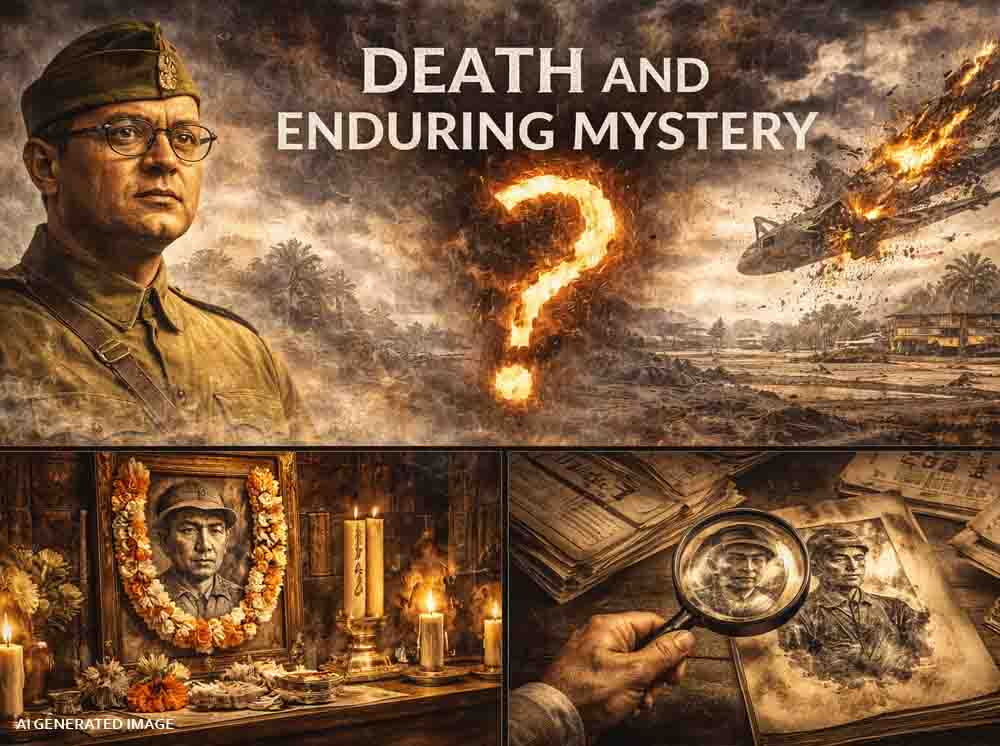
Netaji’s life came to an abrupt and controversial end in 1945. On August 18, while attempting to fly to Tokyo following Japan’s surrender to Allied forces, his plane reportedly crashed in Taiwan (then Formosa). Bose sustained severe burn injuries and died shortly afterward. The exact circumstances of his death have remained the subject of debate, speculation, conspiracy theories, and multiple investigations. Official Indian inquiries have generally upheld the plane-crash account, but some commissions (such as the Mukherjee Commission) questioned aspects of the evidence and even the identity of the ashes interred in Renkō-ji Temple in Tokyo, creating ongoing public fascination and unresolved historical questions. Source: Encyclopedia Britannica The Times of india The Times of india
Chapter 8: Ideology, Differences, and Respect
While Netaji’s methods differed sharply from Gandhi’s philosophy of non-violence, his contribution to India’s freedom struggle was recognized widely. Despite their ideological divergences, Bose held deep regard for Gandhi and acknowledged his central role in India’s liberation and moral leadership. In public addresses — including radio broadcasts — Bose spoke respectfully of Gandhi, calling him the “Father of the Nation” and acknowledging his influence on millions of Indians. Source: Wikipedia
Chapter 9: Legacy — Valor, Controversy, and National Memory
One of India’s most famous liberation warriors is still Subhas Chandra Bose. His legacy is commemorated annually on January 23, celebrated as Netaji Jayanti or Parakram Diwas (“Day of Valor”) — honoring his fearless quest for independence. Source: Wikipedia
Monuments, institutions, and museums — including Netaji Bhawan, Kolkata — preserve his memory, housing archives and relics that chronicle his life and struggle. His writings, including The Indian Struggle, 1920–1942, reflect his intellectual engagement with India’s freedom movement and remain studied by historians and political thinkers worldwide. Source: Wikipedia Wikipedia
Bose’s legacy is complex and sometimes controversial due to his wartime alliances with Axis powers. However, in India, he is celebrated as a symbol of uncompromising resistance, unwavering courage, and an enduring reminder that the pursuit of freedom can take many forms.
Conclusion: The Eternal Flame of Freedom
Netaji Subhas Chandra Bose stands as a towering figure in India’s history — a leader who dared to challenge imperial power with equal parts audacity and discipline. His life illustrated the breadth of India’s freedom movement: from mass civil disobedience and political negotiation to revolutionary fervor and military resistance. His story continues to inspire generations — not just as a leader of an army, but as an embodiment of the eternal quest for liberty and self-determination.
Disclaimer
The information provided by Web Arbiter (‘we’, ‘us’, or ‘our’) on https://webarbiter.in/ . The website is for general informational purposes only. All information on the Site is provided in good faith, however we make no representation or warranty of any kind, express or implied, regarding the accuracy, adequacy, validity, reliability, availability, or completeness of any information on the Site. UNDER NO CIRCUMSTANCE SHALL WE HAVE ANY LIABILITY TO YOU FOR ANY LOSS OR DAMAGE OF ANY KIND INCURRED AS A RESULT OF THE USE OF THE SITE OR RELIANCE ON ANY INFORMATION PROVIDED ON THE SITE. YOUR USE OF THE SITE AND YOUR RELIANCE ON ANY INFORMATION ON THE SITE IS SOLELY AT YOUR OWN RISK. Read Full Disclaimer