


Classical computers have been the foundation of technical advancement for many years. From smartphones and laptops to artificial intelligence and global financial systems, classical computing has shaped the modern world. These machines operate using bits—units of information that can be either 0 or 1.
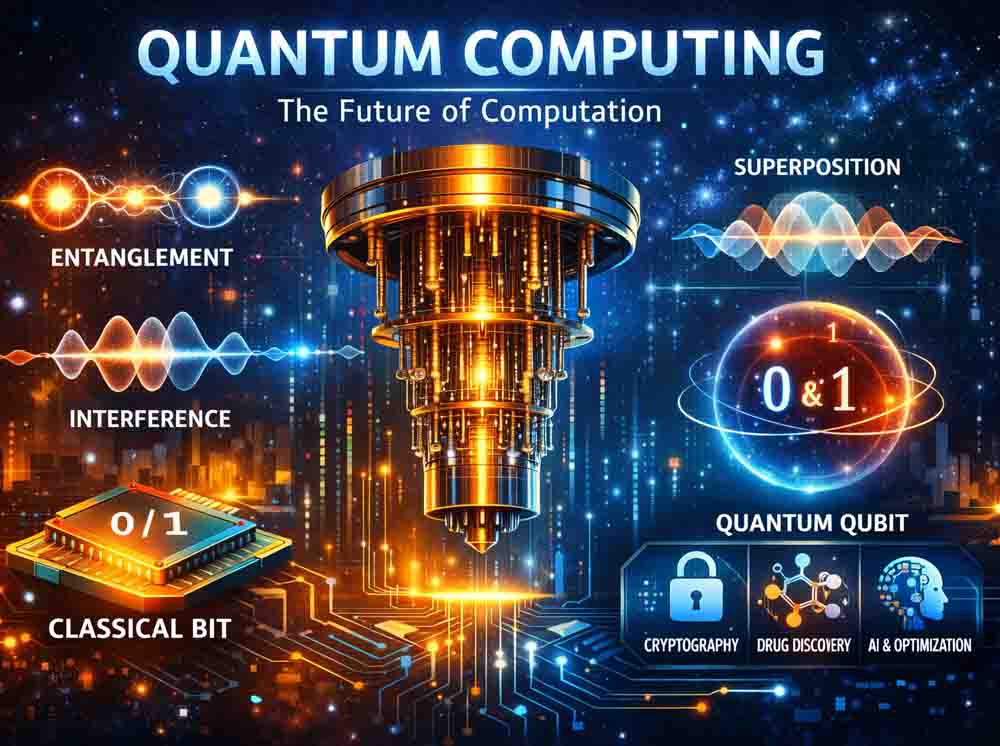
However, as problems become more complex and data volumes explode, classical computers are approaching their physical and computational limits. Tasks such as simulating molecules, breaking encryption, optimizing global logistics, and training massive AI models are becoming increasingly difficult, even for the most powerful supercomputers.
Quantum computing emerges as a revolutionary solution to these challenges. Instead of relying on classical bits, quantum computers use qubits, which can exist in multiple states simultaneously. By leveraging the principles of quantum mechanics, quantum computers promise to solve certain problems exponentially faster than traditional machines.
In this blog, we will explore quantum computing in depth—its foundations, working principles, advantages, applications, challenges, real-world examples, and its future impact on society.
1. Understanding Quantum Computing: The Basics
Quantum computing is a field of computer science and physics that uses quantum mechanical phenomena to perform computations.
Unlike classical computers, quantum computers operate on qubits rather than bits. A qubit can represent both 0 and 1 simultaneously, enabling quantum machines to process multiple possibilities at once.
Key Differences Between Classical and Quantum Computing
Classical computing relies on deterministic logic, while quantum computing is probabilistic in nature.
Classical Computers:
- Use bits (0 or 1)
- Process information sequentially or in parallel
- Are stable and reliable
- Have limitations in solving complex problems
Quantum Computers:
- Use qubits (0, 1, or both)
- Exploit quantum phenomena like superposition and entanglement
- Can solve certain problems faster than classical computers
- Are fragile and difficult to build
2. Core Principles of Quantum Computing
Quantum computing is built on three fundamental principles: superposition, entanglement, and quantum interference.
Superposition
A qubit can exist in several states at once thanks to superposition.
A bit in traditional computing is either 0 or 1.
In quantum computing, a qubit can be 0, 1, or a combination of both.
Example:
- A classical coin lies flat (heads or tails).
- A quantum coin spins in the air (heads and tails at the same time).
Entanglement
Entanglement occurs when two or more qubits become interconnected so that the state of one qubit instantly affects the state of another, regardless of distance.
Key characteristics:
- Entangled qubits share information instantaneously.
- Changes in one qubit affect the other.
- Enables powerful correlations in quantum systems.
Quantum Interference
Quantum interference is used to amplify correct answers and cancel incorrect ones.
This principle is crucial for designing quantum algorithms that produce meaningful results.
3. How Quantum Computers Work
Quantum computers are fundamentally different from classical machines in architecture and operation.
Main Components of a Quantum Computer
A quantum computer consists of:
- Qubits: The basic units of quantum information.
- Quantum gates: Operations that manipulate qubits.
- Quantum circuits: Sequences of quantum gates.
- Measurement systems: Devices that read qubit states.
- Cryogenic systems: Cooling mechanisms to maintain quantum states.
Types of Qubits
Different technologies are used to build qubits, including:
- Superconducting qubits (used by IBM and Google)
- Trapped-ion qubits
- Photonic qubits
- Topological qubits
- Spin-based qubits
Each type has its advantages and limitations.
4. Quantum Algorithms: Unlocking the Power of Quantum Machines
To take use of the special qualities of quantum computing, quantum algorithms are created.
Important Quantum Algorithms
Some of the most influential quantum algorithms include:
- Shor’s Algorithm: Factors large numbers efficiently, threatening modern cryptography.
- Grover’s Algorithm: Searches unsorted databases faster than classical algorithms.
- Quantum simulation algorithms: Model physical systems at the quantum level.
- Quantum optimization algorithms: Solve complex optimization problems.
- Quantum machine learning algorithms: Enhance AI and data processing.
These algorithms demonstrate that quantum computers are not just theoretical devices but practical tools for solving real-world problems.
5. Applications of Quantum Computing
Quantum computing has the potential to transform multiple industries.
5.1 Cybersecurity and Cryptography
Quantum computers could break widely used encryption systems such as RSA and ECC.
This has led to the development of post-quantum cryptography, which aims to create encryption methods resistant to quantum attacks.
Potential impacts:
- Threat to current digital security
- Need for quantum-resistant encryption
- Development of quantum communication systems
5.2 Healthcare and Drug Discovery
Quantum computing could revolutionize medicine by enabling accurate simulation of molecules and chemical reactions.
Key benefits:
- Faster drug discovery
- Better understanding of diseases
- Personalized medicine
- Reduced research costs
Example:
Quantum simulations could help scientists design new drugs for cancer, Alzheimer’s, and rare diseases.
5.3 Artificial Intelligence and Machine Learning
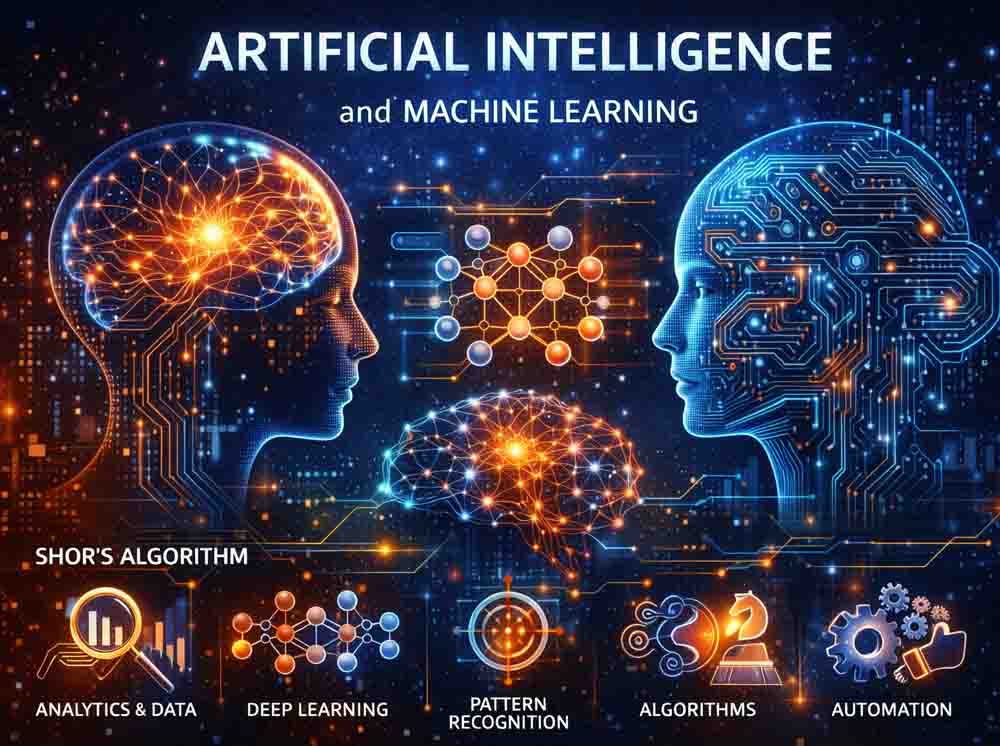
Quantum computing could accelerate machine learning by improving optimization and data processing.
Possible advantages:
- Faster training of AI models
- Better pattern recognition
- Enhanced optimization techniques
Quantum AI is still in early stages but holds immense potential.
5.4 Finance and Banking
Quantum computing can solve complex financial problems such as portfolio optimization and risk analysis.
Applications include:
- Fraud detection
- High-frequency trading
- Risk modeling
- Portfolio optimization
Quantum technology is already being tested by large financial organizations.
5.5 Logistics and Supply Chain
Quantum algorithms can optimize complex logistics systems.
Examples:
- Route optimization
- Inventory management
- Transportation planning
- Warehouse optimization
Quantum computing could significantly reduce costs and improve efficiency.
5.6 Scientific Research
Quantum computing can help scientists solve complex problems in physics, chemistry, and biology.
Potential applications:
- Climate modeling
- Material science
- Quantum chemistry
- Astrophysics
5.7 National Security and Defense
Governments worldwide are investing in quantum computing for strategic purposes.
Uses include:
- Secure communication
- Military simulations
- Intelligence analysis
Quantum technology is becoming a geopolitical asset.
6. Advantages of Quantum Computing
Quantum computing offers several advantages over classical computing.
Major Benefits
- Exponential speedup for certain problems
- Ability to solve complex optimization tasks
- Advanced simulation capabilities
- Improved AI and machine learning
- Breakthroughs in science and medicine
These advantages make quantum computing one of the most promising technologies of the 21st century.
7. Challenges and Limitations
Despite its potential, quantum computing faces significant challenges.
Technical Challenges
- Qubit instability (decoherence)
- High error rates
- Difficulty in scaling quantum systems
- Need for extreme cooling environments
Practical Challenges
- High cost of development
- Limited real-world applications (currently)
- Shortage of skilled professionals
- Integration with classical systems
Ethical and Security Challenges
- Threat to existing encryption systems
- Potential misuse of quantum technology
- Technological inequality between nations
8. Real-World Examples and Case Studies
Google’s Quantum Supremacy Experiment
In 2019, Google claimed quantum supremacy when its quantum processor solved a problem faster than the world’s most powerful classical supercomputer.
This milestone demonstrated the potential of quantum computing.
IBM Quantum Initiative
IBM provides cloud-based access to quantum computers, allowing researchers and developers to experiment with quantum technology.
Quantum Computing in India
India launched the National Quantum Mission to strengthen research and development in quantum technology.
Indian institutions and startups are contributing to global quantum research.
Industry Partnerships
Businesses investigating quantum computing for real-world uses include Microsoft, Amazon, JPMorgan, and Volkswagen.
9. Quantum Computing vs Classical Computing
| Feature | Classical Computing | Quantum Computing |
|---|---|---|
| Data Unit | Bit (0 or 1) | Qubit (0, 1, or both) |
| Processing | Sequential/Parallel | Quantum Parallelism |
| Speed | Limited | Potentially exponential |
| Stability | High | Low |
| Cost | Affordable | Very expensive |
| Applications | General-purpose | Specialized |
10. Future of Quantum Computing
Quantum computing has an exciting and uncertain future.
Short-Term Outlook
- Improved quantum hardware
- Hybrid classical-quantum systems
- Practical applications in niche areas
Long-Term Vision
- Large-scale quantum computers
- Quantum internet
- Breakthroughs in AI and medicine
- Transformation of cybersecurity
Quantum computing may become as transformative as electricity or the internet.
11. Why Quantum Computing Is Important for Humanity
Quantum computing is not just about faster computers; it is about solving problems that are currently unsolvable.
It could help humanity address global challenges such as climate change, disease, energy shortages, and cybersecurity threats.
By expanding the limits of computation, quantum computing could unlock new knowledge and drive innovation across industries.
Conclusion: Entering the Quantum Era
Quantum computing represents one of the most significant technological revolutions in human history.
Although still in its early stages, it has already demonstrated the potential to outperform classical computers in specific tasks.
As research progresses, quantum computing could transform science, industry, and society in profound ways.
The quantum era has begun, and its impact will shape the future of humanity.

Disclaimer
The information provided by Web Arbiter (‘we’, ‘us’, or ‘our’) on https://webarbiter.in/ . The website is for general informational purposes only. All information on the Site is provided in good faith, however we make no representation or warranty of any kind, express or implied, regarding the accuracy, adequacy, validity, reliability, availability, or completeness of any information on the Site. UNDER NO CIRCUMSTANCE SHALL WE HAVE ANY LIABILITY TO YOU FOR ANY LOSS OR DAMAGE OF ANY KIND INCURRED AS A RESULT OF THE USE OF THE SITE OR RELIANCE ON ANY INFORMATION PROVIDED ON THE SITE. YOUR USE OF THE SITE AND YOUR RELIANCE ON ANY INFORMATION ON THE SITE IS SOLELY AT YOUR OWN RISK. Read Full Disclaimer