


In the digital era, every click, search, purchase, and swipe creates data. But raw data alone has no value unless it is understood, interpreted, and used wisely. This is where data science steps in. It has quietly become one of the most powerful forces shaping modern businesses, governments, and technologies.
This blog offers a detailed, easy-to-understand analysis of what data science really is and why it has emerged as one of the most promising career options in today’s data-driven world.
What Is Data Science? (Beyond the Buzzword)
Data science is a multidisciplinary field that focuses on extracting meaningful insights from data to help organizations make smarter decisions, predict future trends, and solve complex problems.
Unlike traditional data analysis, data science combines:
- Statistics and mathematics to understand patterns
- Programming to process large datasets
- Machine learning to build predictive models
- Domain knowledge to apply insights in real-world scenarios
In simple terms, data science answers three critical questions:
- What happened? (Descriptive analysis)
- Why did it happen? (Diagnostic analysis)
- What is likely to happen next? (Predictive analysis)
How Data Science Works: A Practical View
A typical data science workflow looks like this:
- Data Collection – Gathering data from websites, apps, sensors, databases, or APIs
- Data Cleaning – Removing errors, duplicates, and inconsistencies
- Exploratory Data Analysis (EDA) – Finding patterns and trends
- Model Building – Using machine learning or statistical models
- Visualization & Communication – Presenting insights through dashboards and reports
- Decision Support – Helping businesses act on data-backed insights
This process transforms raw numbers into strategic intelligence.
Why Data Science Is So Important in Today’s Digital World
1. Data Is Growing Faster Than Ever
With the rise of smartphones, social media, IoT devices, and cloud platforms, the world generates massive volumes of data every second. To make sense of it, organizations require qualified experts.
2. Businesses Compete on Intelligence, Not Just Products
Modern companies don’t just compete on price or quality—they compete on how intelligently they use data. Data science helps businesses:
- Understand customers better
- Reduce operational costs
- Predict market trends
- Improve products and services
3. Backbone of AI and Automation
Data science provides the foundation for artificial intelligence and machine learning. Without high-quality data and analysis, intelligent systems cannot function effectively.
Why Data Science Is a Strong Career Option
High Demand Across Industries
Data scientists are needed in almost every sector:
- IT & software
- Finance and banking
- Healthcare and pharmaceuticals
- E-commerce and retail
- Media, sports, and entertainment
- Government and public policy
This cross-industry demand makes data science a stable and versatile career.
Attractive Salary and Growth Potential
Due to the shortage of skilled professionals, data science roles offer competitive salaries and fast career growth compared to many traditional jobs.
Future-Proof Career
As automation increases, many routine jobs are disappearing. Data science, however, is enhanced by automation, not replaced by it—making it a future-ready profession.
Meaningful Impact
Data science directly influences real-world decisions such as:
- Detecting financial fraud
- Improving healthcare outcomes
- Optimizing supply chains
- Personalizing user experiences
You don’t just work with data—you shape outcomes.
Career Options in Data Science
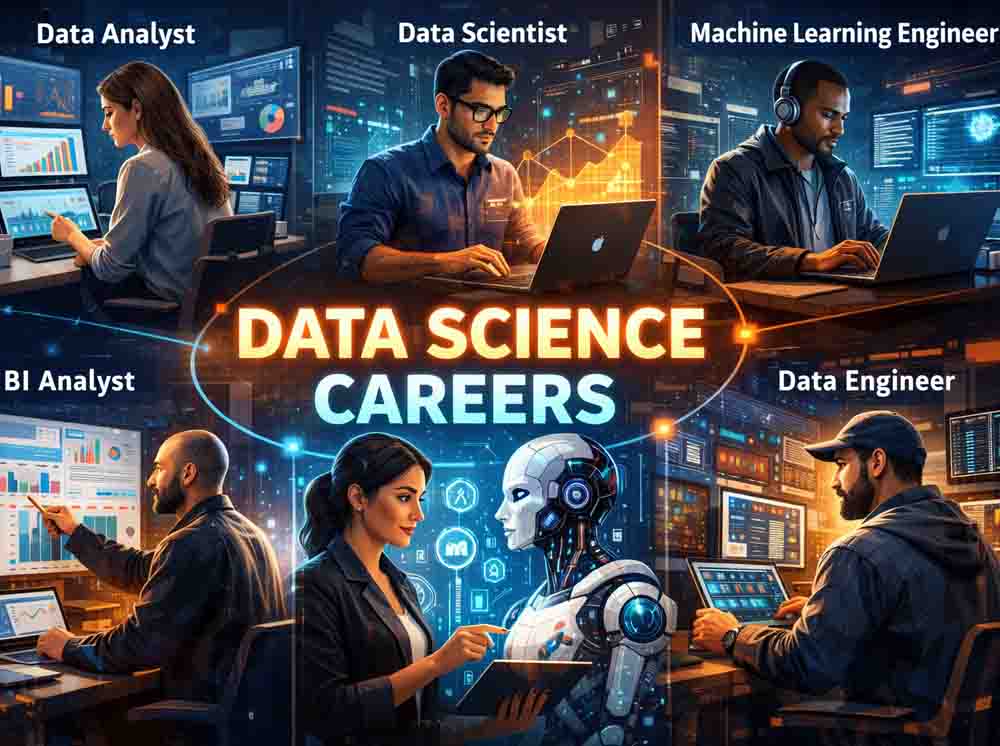
Data science is not a single job role; it opens doors to multiple career paths:
1. Data Analyst
A Data Analyst is responsible for converting raw data into meaningful information that helps businesses make informed decisions. This role focuses on understanding historical data and identifying trends, patterns, and performance gaps.
Key responsibilities include:
- Collecting, cleaning, and organizing data from multiple sources
- Analyzing business metrics such as sales, traffic, and customer behavior
- Creating dashboards, charts, and reports using visualization tools
- Presenting insights to stakeholders in a clear, non-technical manner
Data analysts play a critical role in day-to-day decision-making, helping organizations track performance and improve efficiency.
2. Data Scientist
A Data Scientist goes beyond basic analysis to solve complex business problems using advanced analytics and predictive models. This role combines statistics, programming, and machine learning to forecast future outcomes.
Key responsibilities include:
- Performing deep exploratory data analysis on large datasets
- Building predictive and classification models
- Applying machine learning algorithms to uncover hidden patterns
- Designing experiments and validating data-driven hypotheses
- Communicating insights through data storytelling
Data scientists help organizations anticipate future trends and make strategic, long-term decisions.
3. Machine Learning Engineer
A Machine Learning Engineer focuses on taking machine learning models from experimentation to real-world production. Their primary goal is to build scalable, reliable systems that can learn from data automatically.
Key responsibilities include:
- Developing and optimizing machine learning algorithms
- Training models on large datasets and improving performance
- Deploying models into production environments
- Monitoring model accuracy and retraining when needed
- Collaborating with software and data engineering teams
This role is essential for building AI-powered products such as recommendation systems, fraud detection tools, and voice recognition systems.
4. Business Intelligence (BI) Analyst
A Business Intelligence Analyst bridges the gap between raw data and business strategy. Their focus is on transforming complex datasets into easy-to-understand insights for executives and decision-makers.
Key responsibilities include:
- Designing and maintaining dashboards and KPI reports
- Analyzing business performance and operational efficiency
- Identifying opportunities for growth and optimization
- Working closely with management to support strategic planning
BI analysts help organizations understand what is happening now and guide short-term and long-term business actions.
5. AI Specialist
An AI Specialist applies data science and machine learning techniques to build intelligent systems that can mimic human decision-making and behavior.
Key responsibilities include:
- Developing AI models for automation and prediction
- Working on natural language processing, computer vision, or robotics
- Building chatbots, recommendation engines, and smart assistants
- Improving system accuracy through continuous learning
- Researching and implementing advanced AI algorithms
AI specialists are at the forefront of innovation, shaping the future of automation, smart applications, and digital intelligence.
6. Data Engineer
A Data Engineer builds and maintains the infrastructure that makes data science possible. They ensure that data is accessible, reliable, and ready for analysis.
Key responsibilities include:
- Designing and managing data pipelines and workflows
- Building data warehouses and databases
- Ensuring data quality, security, and scalability
- Integrating data from multiple systems and sources
- Supporting data scientists and analysts with clean, structured data
Without data engineers, advanced analytics and AI systems cannot function effectively.
Competencies Required to Pursue a Data Science Career
To enter and grow in data science, professionals typically develop skills in:
- Programming: Python, R, SQL
- Statistics & probability
- Data visualization tools: Tableau, Power BI
- Machine learning basics
- Problem-solving and critical thinking
Importantly, communication skills are just as vital—because insights must be clearly explained to decision-makers.
Final Thoughts: Is Data Science Worth It?
In a world driven by digital interactions, data has become the most valuable resource, and data scientists are the professionals who unlock its value. Data science is not just a trend—it is a long-term career path that blends technology, creativity, and real-world impact.
If you enjoy working with data, asking “why” and “what next,” and solving meaningful problems, data science offers a powerful, rewarding, and future-proof career in today’s digital world.
Disclaimer
The information provided by Web Arbiter (‘we’, ‘us’, or ‘our’) on https://webarbiter.in/ . The website is for general informational purposes only. All information on the Site is provided in good faith, however we make no representation or warranty of any kind, express or implied, regarding the accuracy, adequacy, validity, reliability, availability, or completeness of any information on the Site. UNDER NO CIRCUMSTANCE SHALL WE HAVE ANY LIABILITY TO YOU FOR ANY LOSS OR DAMAGE OF ANY KIND INCURRED AS A RESULT OF THE USE OF THE SITE OR RELIANCE ON ANY INFORMATION PROVIDED ON THE SITE. YOUR USE OF THE SITE AND YOUR RELIANCE ON ANY INFORMATION ON THE SITE IS SOLELY AT YOUR OWN RISK. Read Full Disclaimer