

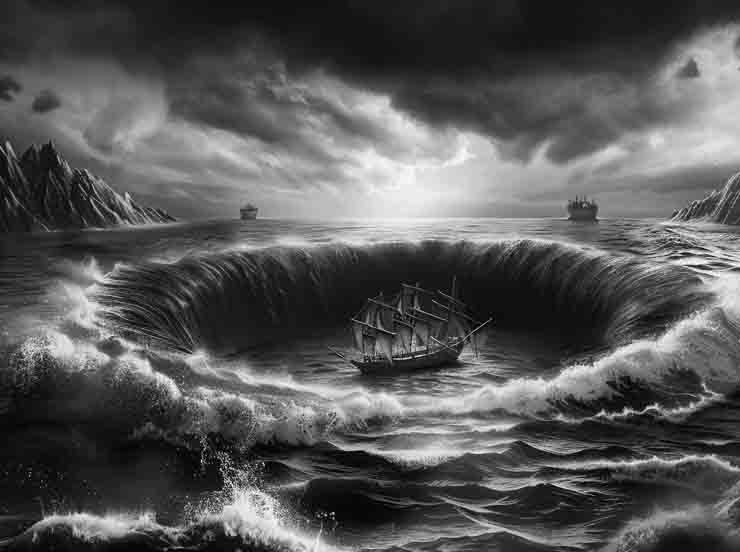

One of the most intriguing and mysterious regions of the planet is the Bermuda Triangle, sometimes known as the “Devil’s Triangle.” Situated in the North Atlantic Ocean’s western region, Between San Juan (Puerto Rico), Bermuda, and Miami (Florida, USA), it forms a triangle. Over the years, this area has gained global attention due to unexplained disappearances of ships and aircraft, sparking numerous theories, legends, and scientific studies. The secrets of the Bermuda Triangle have fascinated researchers, adventurers, and storytellers alike, blending fact, speculation, and myth.

The Geography and Scale of the Bermuda Triangle
The Bermuda Triangle covers approximately 500,000 to 1,500,000 square miles of ocean, depending on how different sources define its boundaries. It lies within a busy shipping and flight corridor used by vessels traveling between the Americas, Europe, and the Caribbean. The area’s unpredictable weather, strong Gulf Stream currents, and deep ocean trenches make it a naturally challenging environment for navigation.
Famous Disappearances
One of the earliest recorded incidents dates back to Christopher Columbus, who reportedly observed strange lights and compass malfunctions while crossing the area in 1492. Over the centuries, numerous ships and planes vanished mysteriously. Among the most famous cases are:
- Flight 19 (1945) – Five members of the U.S. On a training flight, Navy torpedo bombers vanished.A rescue plane sent after them also vanished, leaving no trace.
- USS Cyclops (1918) – A massive U.S. Navy cargo ship with 309 crew members disappeared without sending a distress call.
- The Witchcraft (1967) – A cabin cruiser vanished just one mile from Miami, after contacting the Coast Guard for assistance.
- DC-3 Airliner (1948) – Carrying 32 people, this passenger plane disappeared on a routine flight to Miami.
These events, combined with sensational media coverage, fueled the Bermuda Triangle’s reputation as a dangerous, mysterious place.

Possible Explanations Behind the Mystery
1. Natural Phenomena
Many scientists argue that the disappearances can be explained by natural causes. The region is prone to sudden storms, hurricanes, and waterspouts that can sink ships or disorient pilots. The Gulf Stream, a powerful ocean current, can quickly carry debris away from a disaster site, making wreckage difficult to locate.
2. Compass Variations
The Bermuda Triangle is one of the few places on Earth where true north and magnetic north align, potentially causing compass malfunctions for inexperienced navigators. This could lead to navigational errors and accidents.
3. Methane Hydrates
Some geologists suggest that methane gas trapped under the ocean floor could occasionally erupt, reducing water density and causing ships to sink rapidly. Methane could also interfere with aircraft engines, though evidence for such events remains limited.
4. Human Error
Given the heavy traffic through the Triangle, accidents caused by fatigue, poor navigation, and mechanical failure are not uncommon. Many supposed “mysteries” may simply be attributed to human mistakes compounded by challenging environmental conditions.
5. Piracy and Sabotage
In certain cases, ship disappearances may be linked to piracy or intentional sabotage, especially in earlier centuries when sea trade routes were less secure.
Theories Beyond Science
The Bermuda Triangle’s mystique has also inspired speculative and supernatural theories:
- Alien Abductions: Some claim extraterrestrials use the area as a portal or base.
- Atlantis Connection: Theories suggest that remnants of the lost city of Atlantis, with advanced technologies, lie beneath the Triangle.
- Time Warps or Portals: Stories of sudden time jumps and “electronic fog” suggest disruptions in space-time, although no scientific evidence supports these ideas.
- Sea Monsters or Paranormal Activity: Folklore often attributes disappearances to mythical creatures or ghost ships.
While these theories captivate imaginations, none have been substantiated by credible evidence.
Scientific Investigations and Debunking
Numerous studies have been conducted to analyze the Bermuda Triangle phenomenon. The U.S. Board on Geographic Names does not recognize the Bermuda Triangle as an official geographic area, and the U.S. Coast Guard considers it no more dangerous than any other heavily traveled ocean region. A 2013 report by the World Wide Fund for Nature (WWF) also found no evidence that the Bermuda Triangle is disproportionately hazardous compared to other parts of the ocean.
Journalist Larry Kusche, in his book The Bermuda Triangle Mystery—Solved, argued that many reported disappearances were exaggerated or misreported. Some “mysterious” cases were later found to involve navigational mistakes, bad weather, or mechanical failures.
Modern Technology and Safety Measures
Advances in navigation, weather forecasting, and satellite tracking have dramatically reduced accidents in the Bermuda Triangle. GPS systems, improved ship designs, and better communication technology make it easier to avoid hazards. Today, thousands of ships and airplanes safely cross the Triangle every year without incident.
Cultural Impact and Popularity
Despite scientific explanations, the Bermuda Triangle continues to inspire books, movies, documentaries, and conspiracy theories. Films like The Bermuda Triangle and countless TV specials keep the legend alive, blending mystery and adventure. The phenomenon has become part of popular culture, symbolizing the unknown and humankind’s fascination with unexplored frontiers.
Conclusion
The Bermuda Triangle’s enduring reputation as a mysterious, dangerous zone is a mix of documented incidents, natural hazards, and human imagination. While scientific evidence points to natural explanations—such as storms, strong currents, methane releases, and human error—the area continues to intrigue people worldwide. Far from being a supernatural anomaly, the Bermuda Triangle reminds us of the power and unpredictability of nature, as well as our tendency to seek extraordinary explanations for extraordinary events.
In reality, the secrets of the Bermuda Triangle are less about alien abductions or lost civilizations and more about the complexities of the ocean, the challenges of navigation, and the We use stories to help us understand the unknown.. Even as modern technology demystifies much of the legend, the Bermuda Triangle remains a powerful symbol of mystery and exploration, inviting curiosity and wonder for generations to come.