

In the heart of Pune, Maharashtra, lies a monument that once symbolized royal grandeur, political power, and Maratha pride — the majestic Shaniwarwada Fort. Built in the 18th century as a royal residence for the Peshwas, this architectural marvel now stands as a haunting reminder of betrayal, bloodshed, and tragedy.
Though the fort’s walls echo tales of heroism and governance, they are equally steeped in sorrow and horror. Shaniwarwada has gained infamy as one of India’s most haunted and mysterious places, where, according to legend, the spirit of a young prince still cries for help in the dead of night.
The fort’s haunting reputation, combined with its historical importance, makes it one of India’s most fascinating destinations — a place where glory meets ghostly gloom.
Historical Background of Shaniwarwada
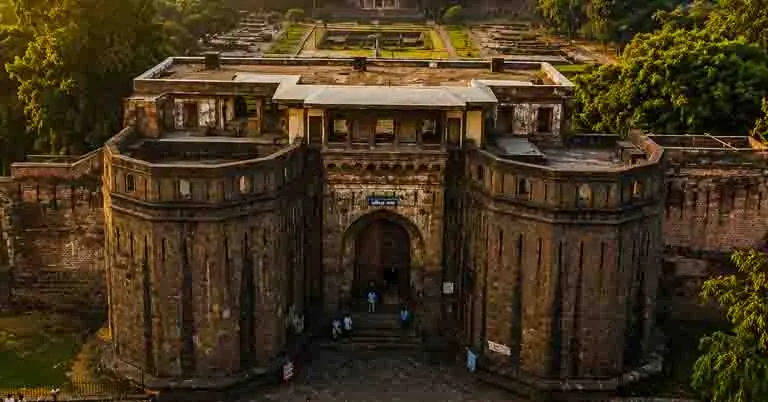
The Shaniwarwada Fort was constructed in 1732 by Peshwa Baji Rao I, one of the most celebrated prime ministers of the Maratha Empire. The word “Shaniwarwada” translates to “Saturday Palace,” named after the day of its foundation.
Baji Rao I envisioned it as a royal residence for the Peshwa family — a grand structure that reflected the power, sophistication, and culture of the Marathas. Built with teak from Junnar, stones from Chinchwad, and lime from Jejuri, the fort stood as a fine example of Maratha and Mughal architectural fusion.
The sprawling complex originally covered over 625 acres, featuring nine bastions, five massive gates, lush gardens, fountains, courtyards, and private chambers. It was not only the political nerve center of the Maratha Empire but also a cultural hub of art, music, and literature.
The Royal Tragedy: The Tale of Narayanrao Peshwa
The haunting of Shaniwarwada is deeply rooted in the gruesome murder of Narayanrao Peshwa, a young prince who met a tragic end within the fort’s walls.
After the death of Madhavrao I in 1772, his younger brother Narayanrao ascended the throne at the tender age of 18. However, his rise to power was marred by family disputes and political conspiracies. His uncle, Raghunathrao (Raghoba), and aunt, Anandibai, had their eyes set on power and control over the Peshwa throne.
According to historical accounts, tensions grew between Narayanrao and Raghunathrao due to differences in administration and influence. At one point, Raghunathrao was placed under house arrest on the orders of Narayanrao. Enraged, Raghoba conspired with his ambitious wife Anandibai to reclaim authority — a plot that would forever stain the history of Shaniwarwada.

The Sinister Twist of Fate
Legend has it that Raghoba wrote a letter to the Gardi guards (Afghan mercenaries) commanding them to capture Narayanrao. The message read, “Narayanrao la dhara” — meaning “Catch Narayanrao.”
However, when the letter reached the guards, Anandibai, Raghoba’s wife, allegedly changed one word. With a single stroke of deception, “dhara” (catch) became “mara” (kill). The altered message now read, “Narayanrao la mara” — “Kill Narayanrao.”
Following the command, the Gardi soldiers stormed into the young Peshwa’s private chambers. Narayanrao, terrified, ran through the corridors of Shaniwarwada screaming for help:
“Kaka! Mala Vachva!” (Uncle! Save me!)
His cries echoed through the palace, but no help arrived. The soldiers brutally murdered the young Peshwa, dismembered his body, and threw the pieces into the nearby Mula-Mutha River.
Narayanrao’s death marked one of the darkest chapters in Maratha history — an event soaked in betrayal, greed, and grief.
The Curse and the Haunting
Since that dreadful night in 1773, people believe that the spirit of Narayanrao Peshwa never found peace. According to local legends, his painful cries still echo through the ruins of Shaniwarwada.
Residents living near the fort have claimed to hear the haunting wail of a young boy crying:
“Kaka! Mala Vachva!”
every Saturday night, the day associated with the fort’s foundation and with Narayanrao’s death.
Even today, security guards and visitors report hearing screams, whispers, and footsteps during quiet nights. Some claim to have seen shadowy figures, while others describe feeling an unexplainable chill or sense of being watched.
Because of these accounts, entry to Shaniwarwada Fort after sunset is prohibited, as locals and authorities alike respect the eerie energy said to permeate the grounds.
The Great Fire of 1828
As if the fort had not seen enough tragedy, another disaster struck in 1828, when a massive fire engulfed the palace. The flames raged for seven days, destroying most of the wooden structures, paintings, and furnishings.
The cause of the fire remains a mystery — some say it was accidental, while others believe it was divine retribution or a continuation of the fort’s cursed fate.
After the fire, Shaniwarwada was never rebuilt to its original glory. Only the stone walls, gateways, and ruins survived, standing today as silent witnesses to centuries of power and pain.
Architectural Grandeur and Symbolism
Despite its haunted reputation, the remnants of Shaniwarwada Fort still display its once-magnificent architecture and design brilliance.
1. The Gates:
There are five grand entrances — Dilli Darwaza, Mastani Darwaza, Khidki Darwaza, Ganesh Darwaza, and Jambhul Darwaza. The Dilli Darwaza, facing north toward Delhi, was the main gate and symbolized the Peshwas’ aspiration to rule over India. Massive spikes on its doors protected it from enemy elephants.
2. The Nagarkhana (Music Hall):
Above the main gate stood the Nagarkhana or drum house, where musicians played ceremonial tunes to announce arrivals and royal gatherings.
3. The Fountain of Twelve Arches (Hazari Karanje):
This splendid fountain, shaped like a lotus, was once one of the most advanced water systems of its time, fed by an intricate network of underground pipes.
4. The Halls and Palaces:
The fort had grand meeting halls, private chambers, and beautifully decorated walls with frescoes depicting scenes from the Ramayana and Mahabharata. The royal residence of Baji Rao and Mastani Bai was known for its luxurious interiors and romantic allure.
Even in ruins, Shaniwarwada’s remnants whisper tales of love, loyalty, power, and revenge.
5. The Legend of Baji Rao and Mastani
Before the tragedy of Narayanrao, Shaniwarwada was also home to one of India’s most legendary love stories — Baji Rao I and Mastani Bai.
Mastani, the daughter of King Chhatrasal of Bundelkhand and a Persian woman, was both beautiful and talented. She became Baji Rao’s beloved companion, but their relationship was frowned upon due to her mixed heritage and Muslim background.
Mastani lived in Shaniwarwada in a separate palace entrance known as Mastani Darwaza. Their romance, though immortalized in history and art, ended tragically. After Baji Rao’s death, Mastani’s fate remains uncertain — some say she died of grief, while others believe she was imprisoned and starved.
Their story, like that of Narayanrao, adds another layer of emotional and spiritual depth to the fort’s haunting legacy.
Supernatural Experiences and Claims
Visitors, guards, and paranormal enthusiasts have shared countless eerie encounters over the years. Some of the most common supernatural occurrences reported include:
- Crying Voices at Night:
The most famous phenomenon — a child’s cries of “Kaka! Mala Vachva!” — are said to echo through the fort’s walls after midnight, especially on full moon nights. - Unseen Presences:
Night guards and maintenance workers claim to feel invisible entities watching or following them. - Temperature Drops:
Sudden chills and changes in temperature occur in certain parts of the fort, particularly near the ruins of Narayanrao’s chambers. - Moving Shadows and Lights:
Visitors have reported seeing faint flickers of light or moving shadows within the fort at night, even though it remains locked. - Dreams and Visions:
Some sensitive individuals who have visited claim to have experienced vivid dreams of ancient Maratha soldiers, courtiers, or a crying child after returning home.
Because of these eerie occurrences, locals avoid going near the fort after dark, and authorities have sealed it at night for safety.
Scientific and Rational Perspectives
While believers hold firmly to the legend of Narayanrao’s restless spirit, skeptics offer rational explanations for the phenomena:
• Echo and Acoustics: The fort’s hollow structure and stone corridors can amplify and distort external sounds, creating the illusion of distant cries.
• Wind and Temperature Variations: Pune’s climate, especially during monsoons and winter nights, can cause whistling sounds and cold air currents.
• Psychological Influence: The fort’s tragic history and widespread ghost stories heighten visitors’ anxiety, leading them to misinterpret ordinary sounds as supernatural events.
Despite such reasoning, the mystery of Shaniwarwada’s haunting continues to captivate imaginations across generations.
Shaniwarwada Today: A Heritage of Mystery
Today, Shaniwarwada is among Pune’s most popular tourist attractions and heritage sites. The fort is managed by the Archaeological Survey of India (ASI) and welcomes thousands of visitors annually.
During the day, the fort bustles with tourists exploring its history, gardens, and ancient walls. However, when evening descends, the mood shifts — the fort grows silent, the air cooler, and the atmosphere heavy with the weight of its past.
The ASI organizes a light and sound show every evening, narrating the glorious history of the Marathas and the Peshwas. Ironically, it takes place just before the time when, according to legend, the young Peshwa’s cries begin to echo.
Cultural and Symbolic Significance
The story of Shaniwarwada is not just about ghosts and tragedy; it symbolizes the rise and fall of power, the fragility of human ambition, and the consequences of betrayal.
- Historically, it reminds us of the once-mighty Maratha Empire that shaped Indian politics before the British era.
- Emotionally, it portrays love, jealousy, and treachery — universal human themes that transcend time.
- Spiritually, it serves as a reflection on the idea of unfinished souls — those who meet untimely deaths and linger between worlds, yearning for justice or closure.
Shaniwarwada, therefore, stands not only as a haunted relic but also as a symbol of India’s layered heritage — where grandeur and grief coexist.

Conclusion
The Shaniwarwada Fort of Pune remains one of India’s most enigmatic sites — a place where history, legend, and the supernatural intertwine. Its grandeur speaks of a glorious past, while its ghostly tales whisper of betrayal and tragedy.
Whether one believes in ghosts or not, the story of Narayanrao Peshwa’s desperate cries continues to stir hearts and imaginations. Every wall, courtyard, and ruin carries echoes of the past — of a young prince who sought mercy, of power struggles that shattered families, and of a fire that tried to erase it all.
And yet, the fort stands. Silent but alive — as though guarding the memories of a bygone era.
As you walk through its corridors, feeling the cool breeze of Pune’s evening air, you might sense a faint voice calling from the distance —
“Kaka! Mala Vachva!”
A haunting reminder that some stories never die.
Disclaimer
The information provided by Web Arbiter (‘we’, ‘us’, or ‘our’) on https://webarbiter.in/ . The website is for general informational purposes only. All information on the Site is provided in good faith, however we make no representation or warranty of any kind, express or implied, regarding the accuracy, adequacy, validity, reliability, availability, or completeness of any information on the Site. UNDER NO CIRCUMSTANCE SHALL WE HAVE ANY LIABILITY TO YOU FOR ANY LOSS OR DAMAGE OF ANY KIND INCURRED AS A RESULT OF THE USE OF THE SITE OR RELIANCE ON ANY INFORMATION PROVIDED ON THE SITE. YOUR USE OF THE SITE AND YOUR RELIANCE ON ANY INFORMATION ON THE SITE IS SOLELY AT YOUR OWN RISK. Read Full Disclaimer