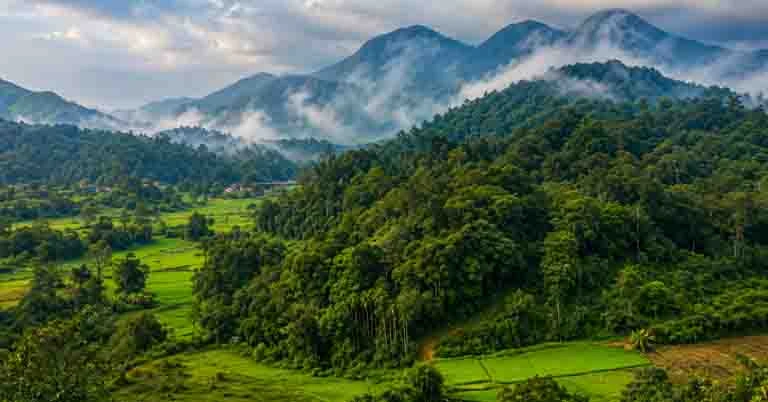


Hidden amidst the serene greenery and tranquil ambiance of Kerala’s sacred landscape, the Anjumoorthy Temple stands as one of the most mysterious and spiritually powerful Shaiva shrines in South India. The very name “Anjumoorthy” (Malayalam: അഞ്ഞുമൂർത്തി) translates to “Temple of Five Idols (or Deities),” signifying its unique distinction — the presence of five self-manifested (Swayambhu) Shiva Lingas within a single sanctum.
This temple is not only an architectural and spiritual marvel but also a living testimony to Kerala’s deep-rooted faith in Lord Shiva, the embodiment of cosmic consciousness. Every aspect of this temple — its legends, rituals, architecture, and festivals — reflects the ancient cultural synthesis that defines Kerala’s temple heritage.
Etymology and Sacred Significance
The name Anjumoorthy is derived from two Malayalam words — Anju meaning “five,” and Moorthy meaning “divine form” or “deity.” Thus, “Anjumoorthy” literally means the temple of five divine forms.
According to belief, these five Lingas represent five distinct manifestations of Lord Shiva — symbolizing His five faces or aspects known in Shaiva philosophy as:
- Sadyojata (Creation)
- Vamadeva (Preservation)
- Aghora (Dissolution)
- Tatpurusha (Concealment)
- Ishana (Revelation)
Together, these aspects signify the cosmic functions of creation, sustenance, destruction, concealment, and grace — the eternal cycle of existence governed by Lord Shiva. Thus, the Anjumoorthy Temple serves as a rare physical and spiritual representation of the Panchamukha Shiva, the Lord with five faces who governs all directions and realms.

Mythological Origins
The Anjumoorthy Temple is wrapped in ancient myth and divine legend. According to local lore, the site was once a dense forest where great sages performed austerities to attain Lord Shiva’s vision. One among them, Sage Parasharan, undertook intense penance for several years. Moved by his devotion, Lord Shiva appeared before him in five radiant forms, symbolizing His five cosmic manifestations. The divine light condensed into five Lingas, which the sage consecrated on the same spot, establishing what is now known as the Anjumoorthy Temple.
Another legend ties the temple to Lord Parasurama, the sixth incarnation of Lord Vishnu and the legendary creator of Kerala. After reclaiming land from the sea, Parasurama is said to have installed 108 Shiva temples and 108 Durga temples across Kerala to protect the newly formed land from spiritual decay. The Anjumoorthy Temple is believed to be one among those sacred 108 Shiva shrines.
Locals also narrate a tale that during a great deluge, five Shiva Lingas from different nearby temples drifted together and rested in one place — the current site of the temple. Taking it as a divine sign, the local rulers built a sanctum around them, calling it Anjumoorthy Kshetram, the temple of the five divine forms.
Historical Background
The Anjumoorthy Temple is believed to be over 1,200 years old, with architectural and epigraphical features suggesting construction during the late Chera or early Venad period. Inscriptions and copper plates discovered near the temple mention donations of land, oil, and paddy to sustain temple rituals and festivals.
During the medieval era, the temple received patronage from local chieftains and later came under the protection of the Travancore royal family, who provided endowments for its upkeep. The temple served as a cultural hub where traditional art forms such as Chakyar Koothu, Koodiyattam, and Vedic chanting flourished.
The Deity and Divine Concept
At the heart of the temple lies its most distinguishing feature — five self-manifested Shiva Lingas enshrined together in the Sreekovil (sanctum sanctorum). Each Linga represents a particular aspect of Lord Shiva’s universal form:
- Sadyojata Shiva – The creator, associated with the west.
- Vamadeva Shiva – The preserver, associated with the north.
- Aghora Shiva – The destroyer of evil, associated with the south.
- Tatpurusha Shiva – The concealer, associated with the east.
- Ishana Shiva – The revealer, symbolizing transcendence, associated with the zenith.
The central Linga, representing Ishana, is slightly elevated above the others, symbolizing the supreme consciousness that transcends all. Together, they form the Panchalinga, embodying the totality of existence — matter, energy, time, consciousness, and space.
Temple Architecture
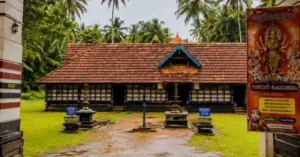
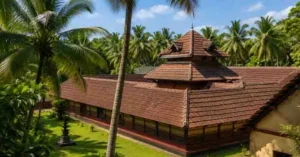
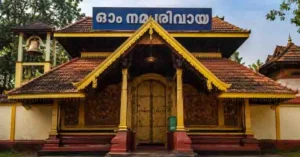
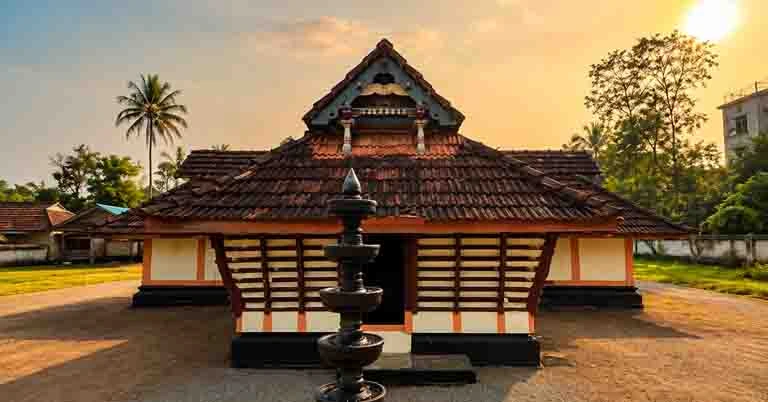
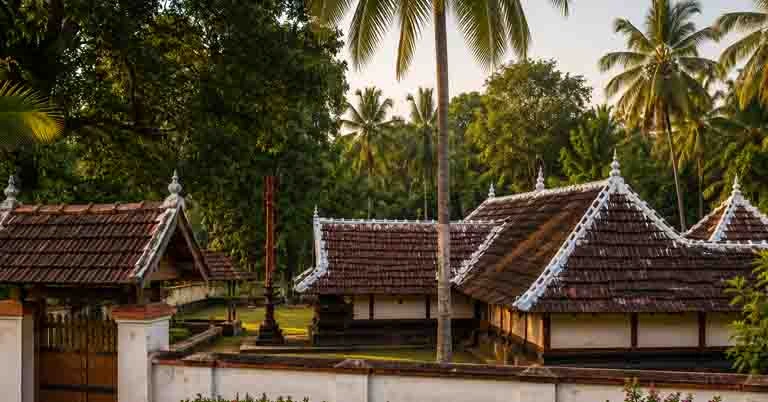
The Anjumoorthy Temple is an excellent example of traditional Kerala temple architecture, blending aesthetic precision with spiritual symbolism. Built primarily from laterite, granite, and teak wood, the structure follows the Vastu Shastra principles that align cosmic energy with the temple’s physical layout.
- The Sreekovil (inner sanctum) is circular (Vatta Sreekovil), representing the infinite cosmos.
- The Namaskara Mandapam in front of the sanctum is a square hall supported by intricately carved wooden pillars, depicting divine figures and floral motifs.
- The Chuttambalam (outer enclosure) provides space for circumambulation and ritual performances.
- A Dwajasthambham (flagstaff) plated with brass stands before the sanctum, symbolizing the axis connecting earth to heaven.
- The Balikkal Pura (offering hall) contains stone platforms where devotees present offerings to the deities.
- A Koothambalam (temple theatre) within the premises hosts ritual arts like Koothu and Koodiyattam.
- The temple pond (Ambala Kulam), located to the east, is used for purification rituals and festival ceremonies.
The outer walls are adorned with ancient murals depicting stories from the Shaiva Puranas, such as Shiva’s cosmic dance (Tandava), Tripurantaka (the destroyer of three cities), and Ardhanarishvara (the half-male, half-female form symbolizing cosmic balance).
Rituals and Worship Practices
The daily worship at the Anjumoorthy Temple is conducted according to Tantric and Vedic traditions, maintaining ancient Shaiva ritual purity. The temple follows the three-pooja system, with the day’s rituals divided into morning, noon, and evening sessions:
- Nirmalyam – Removal of the previous day’s garlands and purification of the sanctum.
- Abhishekam – Ritual bathing of the Lingas with water, milk, honey, and sandalwood paste.
- Usha Pooja – Morning worship invoking the divine energy of Shiva.
- Ucha Pooja – Noon worship symbolizing balance and sustenance.
- Deeparadhana – Evening ritual with lamps and chanting of Rudram.
- Athazha Pooja – Night worship, signifying divine rest and cosmic harmony.
Special rituals include:
- Rudrabhishekam for purification and peace.
- Mrityunjaya Homam for longevity and health.
- Pradosha Pooja for removing karmic burdens.
- Vilwarchana, offering Bilwa leaves, sacred to Lord Shiva.
The temple is especially crowded on Mondays, Pradosham days, and during the auspicious Maha Shivaratri, when devotees observe fasts and stay awake chanting Shiva’s name throughout the night.
Festivals and Celebrations
The temple’s annual festival (Mahotsavam) is celebrated with grandeur during the Malayalam month of Kumbham (February–March). It lasts for ten days, beginning with the Kodiyettam (flag hoisting) and culminating with the Arattu (holy bath) ceremony, where the deities are ceremoniously taken to the temple pond for purification.
The festival features various rituals and cultural programs:
- Utsavabali and Sreebali, symbolizing cosmic balance.
- Pallivetta (divine hunting ceremony), representing Shiva’s victory over evil.
- Ezhunnallathu, a grand procession of the deities on caparisoned elephants accompanied by traditional percussion such as Panchavadyam and Chenda Melam.
- Thalappoli and Vilakku Procession, where devotees carry lamps in reverence.
The most significant event is Maha Shivaratri, marking Shiva’s cosmic dance. Devotees perform Abhishekam, chant Rudram, and light thousands of lamps, transforming the temple into a sea of divine radiance. The day symbolizes victory of light over darkness, knowledge over ignorance, and life over death.
Other important observances include:
- Thiruvathira, celebrated by women for marital harmony.
- Mandala Kalam and Navarathri, featuring special poojas.
- Aadi Krithika, dedicated to Lord Subramanya, one of Shiva’s divine sons.
Sub-Deities and Sacred Spaces
Apart from the main Panchalinga sanctum, the Anjumoorthy Temple houses several Upa Devatas (sub-deities), each with independent shrines:
- Lord Ganapathi – The remover of obstacles, worshipped first in every ritual.
- Lord Subramanya (Murugan) – The divine warrior, symbolizing courage and wisdom.
- Goddess Parvathi (Devi) – The consort of Lord Shiva, embodying love and fertility.
- Naga Devatas – Serpent deities believed to bless fertility and ancestral well-being.
- Lord Ayyappa (Sastha) – The guardian deity ensuring protection of devotees.
These sub-shrines create a divine ecosystem within the temple, representing harmony between various manifestations of divine energy.
Cultural Importance
Beyond religious devotion, the Anjumoorthy Temple has long served as a center of art, culture, and education. The Koothambalam hosted classical performances like Koodiyattam, Tholpavakoothu (shadow puppetry), and Kathakali, bringing mythological stories to life.
The temple’s Annadanam (free food offering) tradition continues to this day, feeding hundreds of devotees during festivals. It also supports local artisans, musicians, and temple craftsmen, preserving Kerala’s intangible cultural heritage.
The surrounding areas are filled with sacred groves (Kavus), ancient banyan trees, and serene ponds, reflecting the eco-spiritual philosophy of Kerala — that divinity resides in every element of nature.
Administration and Preservation
Today, the Anjumoorthy Temple is managed by the Travancore Devaswom Board or local temple trust, ensuring the continuity of ancient rituals and maintenance of temple structures. Preservation projects have focused on restoring ancient murals, maintaining the temple pond, and conserving the sanctum’s original wood carvings.
Modern lighting and drainage systems have been integrated without disturbing the temple’s heritage aesthetics. Eco-friendly measures, such as avoiding plastic and promoting traditional oil lamps, reinforce the temple’s commitment to sustainability and spirituality.
Spiritual Experience
Visiting the Anjumoorthy Temple is an experience of profound inner peace. The gentle sound of temple bells, the fragrance of sandalwood and camphor, and the tranquil reflection of the sanctum in the temple pond evoke a sense of timeless devotion.
Standing before the five Shiva Lingas, one feels the pulsation of divine energy — the unity of the five forms merging into the infinite. Devotees often describe a visit here as spiritually purifying and emotionally uplifting, a rare opportunity to feel oneness with the eternal Lord.
The temple radiates an aura that transcends religious boundaries — where faith transforms into peace, and worship becomes meditation.

Conclusion
The Anjumoorthy Temple stands as a divine jewel in Kerala’s spiritual landscape — a rare shrine where five manifestations of Lord Shiva are enshrined together, embodying the totality of creation and consciousness. Its unique sanctum, timeless legends, and unbroken tradition of worship make it not just a temple, but a living embodiment of Kerala’s spiritual soul.
For devotees, the temple represents a sacred refuge — a place where prayers are heard, sins are washed away, and hearts are filled with divine grace. As one leaves the premises, the echo of “Om Namah Shivaya” lingers in the air, reminding all that the power of Lord Shiva pervades every corner of existence — from the five Lingas of Anjumoorthy to the infinite universe itself.
Disclaimer
The information provided by Web Arbiter (‘we’, ‘us’, or ‘our’) on https://webarbiter.in/ . The website is for general informational purposes only. All information on the Site is provided in good faith, however we make no representation or warranty of any kind, express or implied, regarding the accuracy, adequacy, validity, reliability, availability, or completeness of any information on the Site. UNDER NO CIRCUMSTANCE SHALL WE HAVE ANY LIABILITY TO YOU FOR ANY LOSS OR DAMAGE OF ANY KIND INCURRED AS A RESULT OF THE USE OF THE SITE OR RELIANCE ON ANY INFORMATION PROVIDED ON THE SITE. YOUR USE OF THE SITE AND YOUR RELIANCE ON ANY INFORMATION ON THE SITE IS SOLELY AT YOUR OWN RISK. Read Full Disclaimer