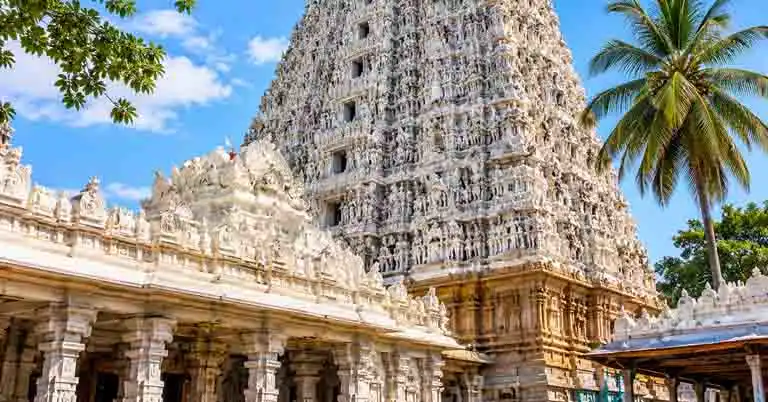

The Suchindram Sthanumalayan Temple, located in the tranquil town of Suchindram, near Kanyakumari in Tamil Nadu, is one of the most fascinating and spiritually significant temples in South India. This temple stands apart because it enshrines the Trimurti — the three supreme aspects of the divine:
- “Sthanu” represents Lord Shiva,
- “Mal” represents Lord Vishnu, and
- “Ayan” represents Lord Brahma.
Hence, the temple is named Sthanumalayan, meaning “the Lord who is Shiva, Vishnu, and Brahma in one form.”
This makes Suchindram one of the rare temples in India where the Holy Trinity of Hinduism is worshipped together, symbolizing the unity of creation, preservation, and dissolution — the eternal cycle of the universe.
Beyond its spiritual significance, the temple is celebrated for its exquisite architecture, musical pillars, and magnificent sculptures, standing as a testament to the artistic brilliance of the Dravidian architectural tradition.
Location and Setting
Suchindram is a picturesque town located about 11 km from Kanyakumari and 7 km from Nagercoil, in the southernmost district of Tamil Nadu. Set along the banks of the Pazhayar River, the temple occupies a serene and sacred landscape that exudes divine tranquility.
The temple’s environment — surrounded by lush greenery, coconut groves, and the distant sight of the Western Ghats — enhances its spiritual aura. The calm, reflective atmosphere perfectly complements the temple’s message of unity and cosmic balance.

Etymology and Mythological Background
The name Suchindram derives from the Sanskrit word “Suchi”, meaning “purity”. The place is associated with the legend of Indra, the king of gods, who was purified of his sins here after a curse.
According to Hindu mythology, Indra once offended the sage Gautama and was cursed with impurity. To atone for his sins, Indra came to this place and worshipped Lord Shiva. After performing deep penance and bathing in the sacred tank here, his sins were washed away, and he regained his purity. Hence, the place came to be known as “Suchindram” — the land of purification.
The temple also embodies the unity of Shaivism, Vaishnavism, and Brahmanism, representing the ultimate spiritual truth that all deities are manifestations of one supreme consciousness.
Historical Background
The history of the Suchindram Temple is ancient, dating back over 1,200 years. Inscriptions and architectural styles indicate contributions from several South Indian dynasties, including the Cholas, Pandyas, and Travancore kings.
Originally built during the early Pandya period, the temple received significant expansions and renovations during the reign of the Travancore royal family, particularly under Marthanda Varma and Rani Gowri Lakshmi Bayi in the 18th and 19th centuries.
It was once under the administrative control of the Travancore Devaswom Board, which managed many important temples in the erstwhile kingdom of Travancore (now part of Kerala and Tamil Nadu).
Architectural Grandeur
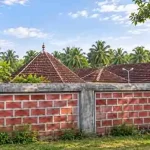
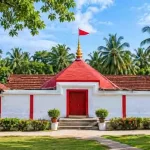
The Sthanumalayan Temple is a masterpiece of Dravidian architecture, reflecting both Tamil and Kerala influences. It covers several acres, featuring towering gateways, long corridors, beautifully carved pillars, and grand mandapams (halls).
1. The Gopuram (Tower)
The temple’s eastern gopuram rises to about 40 meters (130 feet), adorned with hundreds of intricate sculptures depicting gods, goddesses, celestial beings, and mythological scenes. The tower, painted in white, dominates the skyline of Suchindram and serves as a landmark of both art and devotion.
2. The Courtyards and Mandapams
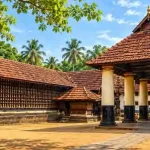
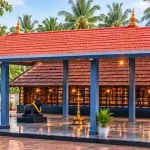
The temple complex comprises three concentric enclosures, each with pillared corridors and sub-shrines. The Alankara Mandapam and Navaratri Mandapam are architectural marvels featuring finely carved granite pillars that produce musical notes when tapped — a rare and remarkable feature found in only a few temples of South India.
3. The Musical Pillars
One of the temple’s greatest attractions is the set of four musical pillars, each about 18 feet high. When struck gently, they emit distinct musical tones corresponding to different notes. These pillars were carved from single blocks of granite, demonstrating the engineering and artistic genius of ancient artisans.
4. The Sanctum (Garbhagriha)
The main sanctum houses the Lingam of Sthanumalayan, representing the combined energy of Shiva, Vishnu, and Brahma. The Lingam is unique — one side represents Shiva (Sthanu), another Vishnu (Mal), and the third Brahma (Ayan). This unification signifies the indivisibility of divine functions — creation, preservation, and destruction.
Inside the sanctum, the atmosphere is profoundly spiritual, with oil lamps flickering, the fragrance of incense, and the resonant chants of priests filling the air.
5. The Sculpture of Hanuman
A colossal 22-foot-tall statue of Lord Hanuman, carved from a single granite stone, stands within the temple complex. It is one of the tallest Hanuman statues in South India and a major attraction for devotees seeking strength, devotion, and courage.
This statue was once buried underground to protect it from invaders and later unearthed and restored during the reign of the Travancore kings.
6. Temple Tank and Surroundings
The temple has a large sacred pond (Theertham), where devotees perform ritual bathing before entering the shrine. The tank is surrounded by steps and stone mandapams, offering a calm, reflective environment for meditation and prayer.
Deities and Sub-Shrines
In addition to the main deity Sthanumalayan, the temple houses several sub-shrines dedicated to:
- Lord Vishnu (Janardhana Perumal)
- Lord Shiva (Mahadeva)
- Goddess Parvati (Amman)
- Lord Subramanya (Murugan)
- Lord Ganapathi (Ganesha)
- Nataraja – the cosmic dancer form of Shiva
- Durga, Lakshmi, and Saraswati – the divine feminine trinity.
This diversity of deities illustrates the temple’s syncretic nature, welcoming devotees of all sects.
Daily Rituals and Worship
The temple follows a rich schedule of daily poojas performed according to the Agama Shastra and ancient Tantric traditions. The rituals are conducted by Shaiva priests, yet incorporate Vaishnavite elements due to the presence of Vishnu in the main sanctum.
Daily Poojas Include:
- Nirmalyam – Removal of previous day’s offerings.
- Abhishekam – Sacred bath with milk, honey, and water.
- Usha Pooja – Morning prayer to awaken the deity.
- Uchikala Pooja – Noon worship, signifying sustenance.
- Deeparadhana – Evening lamp ceremony with chanting.
- Athazha Pooja – Final worship before temple closure.
Devotees also perform archanas with flowers and bilva leaves, and offer ghee lamps, fruits, and coconuts for divine blessings.
Festivals and Celebrations
The Suchindram Temple hosts several vibrant festivals throughout the year, each reflecting deep devotion, community participation, and cultural splendor.
1. The Car Festival (Ther Thiruvizha)
The temple’s most important festival is the Car Festival, held annually in December–January (Margazhi month). During this time, the temple’s deities are taken out in massive wooden chariots, elaborately decorated and pulled through the streets by thousands of devotees.
This festival symbolizes divine grace reaching out to the people, and the sight of the massive chariot rolling through the streets is awe-inspiring.
2. Mahashivaratri
Dedicated to Lord Shiva, Mahashivaratri is celebrated with all-night vigils, chanting of Vedic hymns, and special abhishekams. Devotees observe fasting and meditation, seeking liberation from worldly attachments.
3. Navaratri
During Navaratri, the temple honors the feminine divine — particularly Goddess Saraswati, Lakshmi, and Durga. Music, dance, and cultural programs are organized in the temple courtyard, reflecting the ancient connection between spirituality and art.
4. Vishu and Thiruvonam
As the temple lies near the Kerala border, Vishu (Kerala New Year) and Thiruvonam (Onam) are celebrated with equal enthusiasm. Special poojas, lamps, and floral decorations mark these occasions.
Cultural and Artistic Significance
The Sthanumalayan Temple is not merely a center of worship — it is a repository of South Indian culture and art.
- The sculptures and carvings on the pillars and ceilings depict scenes from Hindu mythology, including the Ramayana and Mahabharata.
- The temple’s musical pillars are marvels of acoustic engineering and a symbol of the harmony between art and spirituality.
- The Hanuman statue, apart from its religious importance, is a masterpiece of monolithic sculpture.
- The temple also served as a center for classical music and dance, with performances dedicated to the deities during festivals.
In every sense, the temple is a living museum of devotion and craftsmanship, preserving centuries-old traditions.
Spiritual Significance
The Suchindram Sthanumalayan Temple conveys a profound spiritual message — the unity of divine forces. In an age when sectarian divisions existed between Shaivites and Vaishnavites, this temple stood as a symbol of religious harmony, teaching that all forms of God are one.
Devotees believe that worshipping at Suchindram grants:
- Purification of sins (as Indra was purified here).
- Harmony in family life and relationships.
- Spiritual enlightenment and liberation (moksha).
- Blessings for success, health, and peace.
The temple’s calm and luminous energy is said to awaken inner balance, representing the union of the material and the divine.
Visitor Information
- Location: Suchindram, Kanyakumari District, Tamil Nadu.
- Distance: 11 km from Kanyakumari, 7 km from Nagercoil.
- Nearest Railway Station: Nagercoil Junction.
- Nearest Airport: Trivandrum International Airport (around 70 km away).
- Temple Timings:
- o Morning: 4:30 AM – 11:30 AM
- o Evening: 5:00 PM – 8:30 PM
Visitors are required to follow traditional dress codes: men should wear dhoti/mundu and remain bare-chested, while women wear saree or traditional attire. Photography inside the sanctum is not permitted.
Conservation and Legacy
The temple is maintained by the Hindu Religious and Charitable Endowments Department of Tamil Nadu. Efforts are underway to preserve its delicate sculptures, musical pillars, and inscriptions. The temple continues to attract not just devotees but also historians, architects, and pilgrims from across the world, intrigued by its artistic brilliance and spiritual inclusivity.

Conclusion
The Suchindram Sthanumalayan Temple is more than a place of worship — it is a spiritual symphony carved in stone. It celebrates the unity of the Trimurti — Shiva, Vishnu, and Brahma — reminding humanity that divinity is one, even though it manifests in many forms.
Its musical pillars sing of ancient genius, its sculptures narrate timeless tales, and its serene sanctum radiates a peace that transcends religion and time.
Visiting Suchindram is not merely an act of pilgrimage — it is a journey into the heart of divine unity, purity, and light.
Disclaimer
The information provided by Web Arbiter (‘we’, ‘us’, or ‘our’) on https://webarbiter.in/ . The website is for general informational purposes only. All information on the Site is provided in good faith, however we make no representation or warranty of any kind, express or implied, regarding the accuracy, adequacy, validity, reliability, availability, or completeness of any information on the Site. UNDER NO CIRCUMSTANCE SHALL WE HAVE ANY LIABILITY TO YOU FOR ANY LOSS OR DAMAGE OF ANY KIND INCURRED AS A RESULT OF THE USE OF THE SITE OR RELIANCE ON ANY INFORMATION PROVIDED ON THE SITE. YOUR USE OF THE SITE AND YOUR RELIANCE ON ANY INFORMATION ON THE SITE IS SOLELY AT YOUR OWN RISK. Read Full Disclaimer